
The best compact power amplifiers deliver useful power without taking over your desk, media console, or listening room. This roundup compares 10 small stereo amps across Bluetooth connectivity, Class-D efficiency, balanced inputs, and installation flexibility.
Whether you need a simple desktop amp, a wireless speaker solution, or a more capable component for passive speakers and subwoofers, these options cover a wide range of budgets and setups.
Best 10 Compact Power Amplifiers Picks for 2026
Best All-Around Power

- 300W per channel with the TPA3255 chip
- Bass and treble controls
- RCA input for passive-speaker systems
Best For: High-output home and desktop audio
Best for Hi-Fi Precision

- Balanced Class-D design
- 140W × 2 at 4 ohms
- TRS and RCA input compatibility
Best For: Hi-Fi and studio-monitoring setups
Best for Wireless Upgrades
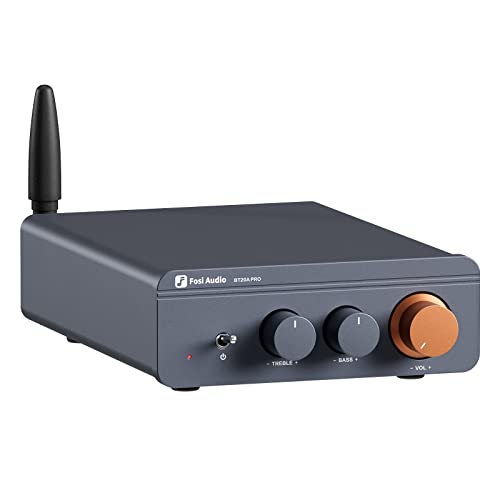
- Bluetooth 5.0 wireless connectivity
- 300W × 2 rated output
- Replaceable op-amps for customization
Best For: Wireless and tweakable passive-speaker systems
Best Budget Mini Receiver

- 50W × 2 stereo output
- Bluetooth, USB, and AUX inputs
- Small footprint with included accessories
Best For: Simple desktop and space-constrained audio
Feature-Packed Choice

- 100W RMS two-channel output
- Bluetooth, FM, USB, SD, and RCA inputs
- Two microphone inputs with EQ controls
Best For: Flexible home audio, karaoke, and computer setups
Ultra-Compact Budget Pick
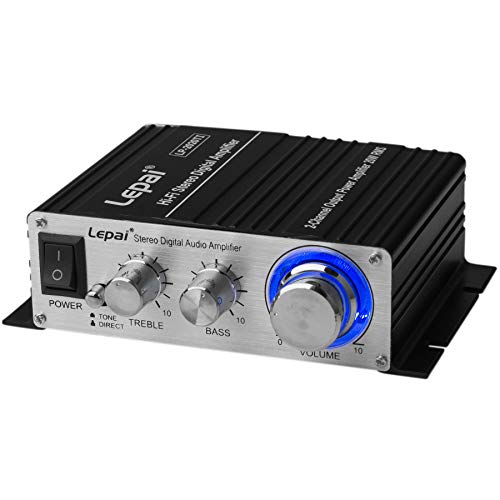
- Up to 20W per channel at 4 ohms
- Compact Class D stereo design
- Includes power supply and one-year warranty
Best For: Bookshelf speakers and small-space audio
Simple Bluetooth Powerhouse
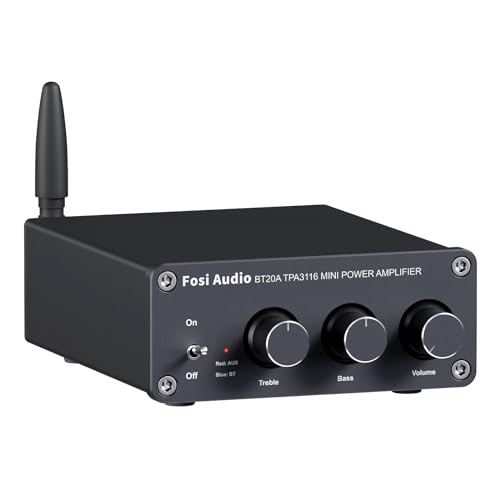
- Up to 100W per channel
- Bluetooth and RCA inputs
- Bass and treble controls in a compact design
Best For: Passive speakers in home, garage, office, or patio setups
Best High-Power Compact Amp
Fosi Audio ZA3 Stereo Amplifier

- Stereo output up to 180W or mono output up to 235W
- Balanced XLR/1/4-inch TRS input and 12V trigger-in
- Supports op-amp rolling and improved cooling
Best For: High-output passive-speaker and home-theater systems
Best Compact PA Receiver

- 40W output with 8-ohm, 25V, and 70V outputs
- Two microphone inputs with MIC 1 talkover priority
- Front controls with bass, treble, and input selection
Best For: Small indoor PA systems and microphone-based setups
Best All-Around Power – Fosi Audio TB10D
For shoppers comparing compact power amplifiers, the Fosi Audio TB10D stands out with substantial stereo output, straightforward wired connectivity, and convenient bass and treble controls. Its TPA3255-based design is rated at 300 watts per channel and works with 2–8-ohm passive speakers.
Best For: Home audio, desktop systems, home theater, and bass-shaker applications.
Pros:
- Up to 300 watts per channel for compatible passive speakers
- Bass and treble controls allow easy sound adjustments
- RCA input and passive speaker output integrate with common audio equipment
- Built-in protection circuits support stable operation
Cons:
- Connectivity is wired rather than Bluetooth-based
- Requires a separate source or preamp for some setups
The TB10D is a practical choice when you want high output in a small enclosure without a complicated feature set. Its flexible speaker compatibility and tone controls make it especially useful for upgrading a simple passive-speaker system.
Best for Hi-Fi Precision – TOPPING Mini300
Among compact power amplifiers, the TOPPING Mini300 targets listeners who prioritize measured clarity and flexible system integration. Its balanced Class-D design delivers up to 140 watts per channel at 4 ohms, while balanced TRS and unbalanced RCA inputs support DACs, preamps, and audio interfaces.
Best For: Hi-Fi listening, studio monitoring, and clean desktop systems.
Pros:
- Fully balanced Class-D amplification minimizes noise and interference
- Very low stated distortion and 124dB signal-to-noise performance
- Supports both balanced TRS and unbalanced RCA inputs
- TRIG control can synchronize power with connected equipment
Cons:
- Designed for systems using a separate source or preamp
- Does not list Bluetooth connectivity
- One-year manufacturer warranty is specified
The Mini300 is a strong fit for a compact, detail-focused setup where balanced connectivity and low noise matter. Its aluminum chassis, cooling vents, and automatic power synchronization add convenience without taking much desk space.
Best for Wireless Upgrades – Fosi Audio BT20A Pro
The Fosi Audio BT20A Pro is one of the more flexible compact power amplifiers for listeners who want wireless convenience alongside strong stereo output. Bluetooth 5.0 joins a 300-watt-per-channel Class-D design, while bass and treble controls and replaceable op-amps allow further system customization.
Best For: Wireless home audio, passive bookshelf speakers, and customizable stereo systems.
Pros:
- Bluetooth 5.0 provides convenient wireless audio pairing
- Rated at 300 watts per channel with the TPA3255 chip
- Replaceable op-amps support optional sound customization
- Bass and treble controls make quick adjustments simple
Cons:
- Bluetooth pairing requires a button press-and-hold procedure for removal
- Op-amp upgrades are optional and require separately sourced parts
The BT20A Pro makes sense when you need a small amplifier that can serve both streaming and traditional passive-speaker setups. Its high output and upgradeable circuitry offer more flexibility than a basic wireless mini amp.
Best Budget Mini Receiver – Facmogu F900S
If your priority is a small, accessible setup, the Facmogu F900S is a practical entry among compact power amplifiers. It supplies 50 watts per channel and combines Bluetooth 5.0 with USB and 3.5mm AUX inputs, making it easy to connect common devices to passive speakers.
Best For: Desktop audio, racing simulators, RVs, workshops, garages, and other tight spaces.
Pros:
- Compact design fits under a monitor or in other restricted spaces
- Bluetooth 5.0, USB, and 3.5mm AUX inputs cover common sources
- 50 watts per channel suits many 4–8-ohm passive speakers
- Includes power adapter and connection cables
Cons:
- Lower rated output than the other amplifiers in this roundup
- Not compatible with Amazon Echo or Alexa devices
- Power-on and mode-switch voice announcements cannot be changed
The F900S is best viewed as a compact, convenient receiver rather than a high-power amplifier. Its multiple inputs, included accessories, and small footprint make it a useful solution for everyday desktop or space-constrained listening.
Feature-Packed Choice – Pyle PDA29BU.5
The Pyle PDA29BU.5 is one of the more versatile compact power amplifiers for home audio, karaoke, or computer listening. It combines 100 watts of RMS continuous power with Bluetooth, FM radio, USB, SD, RCA, and microphone inputs in a small two-channel chassis.
Best For: Buyers who want broad input support, microphone connectivity, and simple remote-controlled operation.
Pros:
- Supports Bluetooth, RCA, USB, SD, FM radio, AUX, and two 1/4-inch microphone inputs.
- Provides 100 watts of RMS continuous power and supports two stereo speakers.
- Includes bass, treble, microphone, and master-volume controls plus a digital LED display.
Cons:
- Its many features may be unnecessary for a basic two-channel setup.
- The listed 200-watt figure is peak power; continuous output is specified as 100 watts.
Choose this model when flexibility matters more than having a minimalist interface. Bluetooth streaming and multiple physical media inputs make it adaptable, while the microphone inputs add useful karaoke and presentation functionality.
Ultra-Compact Budget Pick – Lepai LP-2020TI
The Lepai LP-2020TI is a straightforward choice among compact power amplifiers for small passive-speaker systems. Its Class D design delivers up to 20 watts per channel at 4 ohms, making it suited to bookshelf speakers, TV audio enhancement, and space-constrained setups.
Best For: Small rooms, bookshelf speakers, and listeners who need an efficient mini amplifier with a low-power output.
Pros:
- Very compact and lightweight at 15.2 ounces.
- Class D circuitry offers an energy-efficient solution for limited spaces.
- Supports up to 20 watts per channel at 4 ohms and includes a power supply.
Cons:
- Its 20-watt-per-channel maximum output is much lower than larger amplifiers.
- The supplied notes do not list Bluetooth or multiple source inputs.
This is a practical pick for modest listening levels rather than large spaces or demanding speakers. Its small footprint and simple digital-amplifier design keep the focus on powering a basic stereo system efficiently.
Simple Bluetooth Powerhouse – Fosi Audio BT20A
The Fosi Audio BT20A is a compact power amplifier built for passive speakers in home, office, garage, patio, and similar spaces. With up to 100 watts per channel, Bluetooth and RCA inputs, and simple bass and treble controls, it offers a focused setup without unnecessary features.
Best For: Users who want strong two-channel output and easy Bluetooth streaming for passive speakers.
Pros:
- Offers up to 100 watts per channel for powering multiple speaker cabinets.
- Provides Bluetooth and RCA input options.
- Compact, all-black design with one-touch power and bass/treble controls.
Cons:
- It does not list USB, SD, FM radio, or microphone inputs.
- The design is intentionally simple, so advanced source and control features are limited.
The BT20A makes sense when you want a clean, uncomplicated amplifier for passive speakers rather than an all-in-one receiver. Its Bluetooth support and high stated maximum output provide useful everyday flexibility across indoor and outdoor spaces.
Best Mini Bluetooth Pick – Nobsound 100W Bluetooth Amplifier
If you need compact power amplifiers for a desktop, office, or small home audio setup, the Nobsound offers a strong feature-to-size ratio. Its one-hand-sized aluminum enclosure delivers up to 50W per channel and supports Bluetooth 5.0, AUX, and USB inputs, including lossless playback through USB.
Best For: Desktop listeners and small stereo systems that need flexible wired and wireless input options.
Pros:
- Compact aluminum design measuring 2.76 x 3.07 x 1.5 inches.
- Up to 100W total output, rated at 50W per channel.
- Bluetooth 5.0, AUX, USB, and included RCA connectivity.
- Includes a 19V power supply and necessary audio cables.
Cons:
- Designed for two-channel stereo rather than multiroom or professional PA use.
- Requires a wired power connection.
The Nobsound is a practical choice when space is limited but you still want multiple input options and meaningful stereo output. Its included accessories also make setup straightforward.
Best High-Power Compact Amp – Fosi Audio ZA3 Stereo Amplifier
Among compact power amplifiers, the Fosi Audio ZA3 stands out for higher output and system flexibility. It can operate in stereo mode at up to 180W or mono mode at up to 235W, making it suitable for demanding passive-speaker, subwoofer, desktop, and home-theater configurations.
Best For: Enthusiasts who want a compact amplifier with high output, balanced connectivity, and upgrade options.
Pros:
- Switchable stereo and mono modes for flexible system design.
- Up to 180W in stereo or 235W in mono operation.
- Balanced XLR/1/4-inch TRS input and 12V trigger-in support.
- Improved ventilation, dust covers, and swappable DIP8 op-amps.
Cons:
- Its 48V power supply and advanced features may be more than a basic desktop setup requires.
- Op-amp rolling requires compatible replacement components and additional setup.
The ZA3 is the most scalable option in this group. Its mono capability, balanced input, trigger connection, and op-amp support make it especially appealing for listeners building or refining a more serious system.
Best Compact PA Receiver – Pyle PCM20A.5 40W Amplifier
For buyers comparing compact power amplifiers for announcements, presentations, or small speaker systems, the Pyle PCM20A.5 offers practical PA-oriented connectivity. It provides 40W of output, AUX input, two microphone inputs, and COM, 8-ohm, 25V, and 70V speaker outputs in a compact corded design.
Best For: Small indoor PA systems, presentations, and installations using microphones or distributed speakers.
Pros:
- Supports COM, 8-ohm, 25V, and 70V speaker connections.
- Two 1/4-inch microphone inputs, with MIC 1 talkover priority.
- Independent input volume controls plus bass and treble adjustment.
- Front-panel controls, LED indicator, and detachable AC power cable.
Cons:
- 40W output is lower than the other amplifiers in this roundup.
- It is corded and lacks Bluetooth or USB audio input.
- The larger enclosure is less suited to ultra-compact desktop use.
The Pyle is a sensible pick when microphone support and flexible speaker wiring matter more than wireless music playback. Its transformer-compatible outputs make it more installation-focused than typical mini stereo amplifiers.
How We Picked the Best Compact Power Amplifiers
We selected these Compact Power Amplifiers based on their stated output, supported speaker loads, input options, physical format, and intended use. The list includes straightforward analog mini amps, Bluetooth receivers, feature-rich stereo units, and higher-performance Class-D designs. Because amplifier power claims can vary by impedance, distortion level, power supply, and channel conditions, treat wattage as a comparison point rather than a guarantee of real-world performance.
We also considered whether each model suits a specific buyer: desktop listeners, bookshelf-speaker owners, outdoor users, home-theater builders, and shoppers seeking the lowest-cost route to powered passive speakers.
Quick Comparison
- Best for simple desktop systems: Low-cost mini amplifiers such as the Lepai LP-2020TI are compact and uncomplicated.
- Best for wireless listening: Bluetooth-equipped models from Fosi Audio, Facmogu, Nobsound, and Pyle reduce cable clutter.
- Best for higher output: TPA3255-based options, including the Fosi Audio BT20A Pro and ZA3, are designed for more demanding passive-speaker setups.
- Best for extra connectivity: Pyle models add features such as USB, SD, microphone inputs, FM radio, or distributed-speaker connections.
Key Buying Factors for Compact Power Amplifiers
Power and Speaker Compatibility
Check the amplifier’s rated output at the impedance of your speakers, commonly 4 or 8 ohms. Avoid judging performance by the largest headline wattage alone. Also verify whether the unit is intended for passive speakers; powered speakers generally do not need an external power amplifier.
Inputs and Wireless Features
Bluetooth is convenient for phones and tablets, while RCA and AUX inputs work well with televisions, streamers, and older sources. USB, SD, microphone, and FM features can be useful, but they may add controls you do not need. Balanced inputs are valuable when connecting compatible audio equipment over longer cable runs or in systems where noise control matters.
Size, Cooling, and Power Supply
Small Class-D amplifiers usually run efficiently, but they still need ventilation. Leave space around the chassis and confirm whether the included power adapter is suitable for the desired output. A compact enclosure is helpful only if it can operate reliably in your installation.
Sound Quality and Controls
Look for clear specifications covering total harmonic distortion, signal-to-noise ratio, and frequency response, but remember that system performance also depends on speakers and source quality. Tone controls, gain adjustment, mono mode, and subwoofer integration may matter more than marginal specification differences.
Who Should Buy Which Compact Power Amplifiers?
Choose a basic mini amplifier if you need an inexpensive solution for efficient bookshelf speakers or a small desk. Pick a Bluetooth model if convenient phone streaming is the priority. Buyers powering larger passive speakers or seeking more headroom should consider a higher-output TPA3255 design and confirm the speaker impedance first. For karaoke, announcements, multi-input systems, or distributed audio, a feature-rich Pyle receiver may be more practical than a minimalist stereo amp. Finally, choose the Fosi Audio ZA3 or another flexible component-style model when you want a compact foundation that can grow with a more ambitious home-audio system.