
For musicians, cassette recording remains a practical way to capture song ideas, rehearse away from a computer, or add distinctive tape character to a track. The right recorder depends on whether you need portability, instrument or microphone input, tape duplication, or convenient digital conversion.
We selected 10 cassette recorders across portable, boombox-style, and full-size deck designs. Use the buying guide below to compare recording flexibility, connectivity, power options, and the features that matter most in a working musician’s setup.
Best 10 Cassette Recorders for Musicians Picks for 2026
Best Dual-Deck Workstation

- Records and plays on both cassette decks
- USB output for PC/Mac digital archiving
- Mic mixing, pitch control, dubbing, and repeat modes
Best For: Home studios and musicians needing versatile dual-deck recording
Best Portable Digital Companion

- Converts tapes directly to MP3
- Includes 16GB SD card and earphones
- Built-in microphone with rechargeable battery
Best For: Portable tape listening, archiving, and quick musical idea capture
Best All-in-One Boombox
KLIM Portable Cassette Recorder

- Records USB, radio, or microphone input to cassette
- Adds Bluetooth, AM/FM radio, and USB playback
- Works from AC power or four C batteries
Best For: Portable rehearsals, casual performances, and multi-source tape recording
Best for Tape Dubbing
PyleUsa PT659DU.5 Cassette Deck

- Normal- and high-speed cassette dubbing
- USB cassette-to-MP3 transfer for PC and Mac
- RCA connections, CrO2 support, and level controls
Best For: Home cassette duplication and digital tape transfers
Portable AM/FM Pick
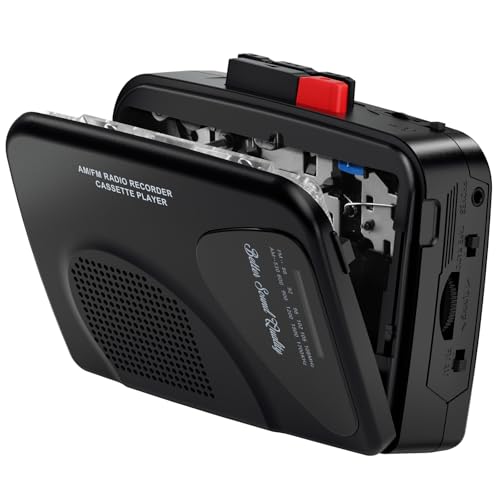
- Records external audio and AM/FM broadcasts
- Built-in speaker and 3.5mm headphone output
- Uses two AA batteries or 5V DC power
Best For: Portable voice notes, radio sampling, and casual mixtapes
One-Touch Recording Choice

- One-touch recording for quick operation
- Built-in and external microphone options
- Includes headphone and AUX inputs
Best For: Simple microphone recording and connected audio use
USB Conversion Pick
QFX Retro-39BT Shoebox Recorder

- Converts cassette audio to MP3 on USB
- Records Bluetooth, FM, USB, and line-in audio to tape
- Adds built-in mic, Bluetooth, and FM
Best For: Cassette archiving, retro sampling, and flexible mixtape creation
Simple All-Purpose Pick

- Built-in mic for quick audio capture
- Battery or AC powered
- Headphone jack and aux input
Best For: Simple voice notes, practice ideas, and portable cassette playback
Best Heavy-Duty Pick
JENSEN MCR-100 Cassette Recorder

- One-touch recording control
- Automatic level control
- Aux input and external mic jack
Best For: Easy mobile recording of music, notes, and lectures
Best Included Accessories

- Records through mic or aux input
- External mic, cable, and AC adapter included
- Built-in speaker and carrying handle
Best For: Recording digital-device audio or performances to cassette
Best Dual-Deck Workstation – TEAC W-1200B Cassette Deck
TEAC W-1200B Dual Cassette Deck with Recorder with USB Pitch Control Karaoke-Mic-in and Remote
Check Price On AmazonFor musicians comparing cassette recorders for musicians, the TEAC W-1200B is a versatile home-deck option with recording on both independent cassette mechanisms. It adds mic mixing, pitch control, dubbing, and USB output for archiving tapes to a computer at up to CD-quality resolution.
Best For: Musicians and home studios that need dual-deck recording, tape duplication, microphone mixing, and computer-based cassette archiving.
Pros:
- Records and plays on both cassette decks, with parallel recording available.
- USB output supports digital recording to PC or Mac at up to 48kHz/16-bit PCM.
- Offers mic mixing, 12% pitch control, A-B repeat, noise reduction, and Type I/II tape support.
Cons:
- Its component-style design is intended more for stationary home use than portability.
- Metal tapes are playback-only, according to the supplied specifications.
The W-1200B is the most feature-rich choice here for musicians who want traditional cassette workflows alongside straightforward digital transfer. Its dual recording paths and broad control set make it especially useful for demos, mix tapes, and tape-library preservation.
Best Portable Digital Companion – KLIM K7 Cassette Player
The KLIM K7 is a compact option for musicians seeking cassette recorders for musicians with simple portable recording needs. It converts cassette audio to MP3 on the included 16GB SD card and also records voice or musical ideas through its built-in microphone, though it does not record onto cassette tape.
Best For: Musicians who want a lightweight tape player, quick MP3 conversion, and portable voice or idea recording.
Pros:
- Converts cassette tapes to MP3 without requiring an app or additional device.
- Includes a 16GB SD card, card reader, earphones, and rechargeable 1000mAh battery.
- Built-in microphone and speaker support convenient recording and playback.
Cons:
- Does not record audio onto cassette tapes.
- Its built-in microphone is better suited to casual ideas or notes than a dedicated studio recording setup.
The K7 emphasizes portability and digital convenience rather than traditional tape-based production. It is a practical choice for capturing sketches on the move and preserving cassette material as MP3 files.
Best All-in-One Boombox – KLIM Portable Cassette Recorder
For musicians who want cassette recorders for musicians with flexible playback and recording sources, this KLIM boombox combines a cassette deck with AM/FM radio, USB playback, Bluetooth, and a built-in microphone. It can record radio, USB audio, or microphone input directly onto cassette tapes.
Best For: Musicians and casual performers who want an easy-to-use, portable cassette recorder with multiple input sources and built-in sound.
Pros:
- Records from USB, the built-in microphone, or AM/FM radio onto cassette.
- Supports Bluetooth streaming, USB playback, radio listening, and cassette playback.
- Offers a 3W stereo speaker, earphone jack, handle, and AC or battery operation.
Cons:
- Four C-cell batteries are required for portable use and are not included.
- The supplied notes do not indicate USB-to-MP3 cassette conversion.
This model suits musicians who value convenience and varied recording sources over specialized deck controls. Its boombox format makes it useful for rehearsals, informal performances, and recording spoken or musical material directly to tape.
Best for Tape Dubbing – PyleUsa PT659DU.5 Cassette Deck
The PyleUsa PT659DU.5 is a practical home deck for musicians comparing cassette recorders for musicians and prioritizing duplication. Its two cassette bays support playback on both decks, while deck B handles recording and dubbing, including normal- and high-speed copying.
Best For: Home users and musicians who need straightforward cassette duplication, CrO2 support, and USB transfer to a computer.
Pros:
- Provides normal- and high-speed dual-deck dubbing.
- Converts cassette music to MP3 on PC or Mac via the included USB cable.
- Includes RCA input and output, CrO2 support, recording-level control, and noise reduction.
Cons:
- Only deck B records or dubs, limiting simultaneous recording flexibility.
- It is a relatively heavy, stationary unit at 11.47 pounds.
The PT659DU.5 is best viewed as a dedicated dubbing and transfer deck rather than a portable songwriting recorder. It offers useful connection and level controls for home tape management, especially when making copies or moving cassette material to MP3.
Portable AM/FM Pick – Compact Cassette Recorder
For musicians seeking cassette recorders for musicians, this compact Mersoco model offers straightforward tape playback and recording in a portable package. It can record external sound or AM/FM broadcasts, and it includes both battery and DC power options for flexible use.
Best For: Musicians who want a lightweight recorder for quick ideas, voice notes, radio sampling, or casual mixtapes.
Pros:
- Records external sounds and AM/FM broadcasts to cassette.
- Includes built-in speakers, a 3.5mm headphone connection, and a USB-to-DC cable.
- Runs on two AA batteries or a 5V DC power supply.
- Compact controls include play, record, fast-forward, and rewind.
Cons:
- Its listed frequency response is 125–6.3 kHz, so it is better suited to basic recording than detailed studio capture.
- AA batteries are not included.
This is a practical entry-level choice when portability and simple recording matter more than advanced connections or high-fidelity production features.
One-Touch Recording Choice – Proscan Cassette Recorder
PROSCAN Cassette Player & Recorder with Microphone, Headphone Jack, Aux in, Black
Check Price On AmazonThe Proscan PRC124AMZ is a simple option among cassette recorders for musicians, combining cassette playback and recording with a built-in microphone, external microphone input, and AUX input. Its carry handle and AC/DC operation make it useful for moving between rooms or recording sessions.
Best For: Musicians and creators who want easy one-touch recording with microphone flexibility and AUX connectivity.
Pros:
- One-touch recording is designed for quick operation.
- Includes both a free-standing microphone and an external microphone jack.
- Automatic level control is intended to support clear recordings.
- Offers headphone and AUX inputs plus AC/DC operation.
Cons:
- At 1.74 pounds, it is less pocket-friendly than smaller portable tape players.
- The supplied notes do not specify battery requirements or recording frequency response.
Choose this model when accessible controls and microphone options are more important than a highly compact design. The AUX input also gives it added flexibility for connected audio sources.
USB Conversion Pick – QFX Retro-39BT Shoebox Recorder
The QFX RETRO-39BT stands out among cassette recorders for musicians by adding Bluetooth, FM, USB playback, and cassette-to-USB MP3 conversion. It also records to tape from USB, Bluetooth, FM, microphone, or line-in sources, although its mono speaker is intended for personal listening rather than full-range musical playback.
Best For: Musicians who want a retro cassette recorder with convenient USB archiving and multiple playback sources.
Pros:
- Converts cassette, Bluetooth, FM, microphone, or line-in audio to MP3 on a USB drive.
- Can record USB, Bluetooth, FM, or line-in audio to cassette for mixtapes.
- Includes a built-in microphone, one-touch recording, and auto-stop at tape end.
- Supports AC power or four C batteries.
Cons:
- The single mono speaker is designed for voice and personal listening, not party-level sound.
- USB recording requires a USB drive; there is no SD card slot.
- Tape recordings may include natural hiss.
This is the most feature-rich option of the three for moving audio between cassette and digital formats. Its USB workflow is useful for archiving ideas, while the mono speaker makes headphones or an external speaker preferable for critical listening.
Simple All-Purpose Pick – Coby Cassette Player/Recorder
For shoppers comparing cassette recorders for musicians, the Coby CVR-22 is a straightforward option for playing tapes and capturing basic audio. Its built-in microphone, simple controls, and battery-or-AC operation make it convenient for quick voice notes, practice ideas, lectures, and interviews.
Best For: Musicians and casual users who want an uncomplicated portable recorder with built-in-mic recording.
Pros:
- Plays cassettes and records audio in one compact device.
- Built-in microphone supports quick voice-note and interview recording.
- Runs on four C batteries or AC power.
- Includes a headphone jack and aux input for flexible listening.
Cons:
- Its built-in microphone is oriented toward basic speech recording rather than specialized music capture.
- Four C batteries are required for battery operation.
- Controls and recording features are intentionally simple.
The Coby is a practical choice when ease of use and flexible power matter more than advanced musician-focused controls. It suits rough musical ideas and everyday recording tasks.
Best Heavy-Duty Pick – JENSEN MCR-100 Cassette Recorder
Among cassette recorders for musicians, the JENSEN MCR-100 stands out for one-touch recording and automatic level control. It can play and record cassettes, accept audio through its auxiliary input, and travel easily with its retractable handle.
Best For: Musicians, students, and mobile users who prioritize simple recording with automatic volume management.
Pros:
- One-touch recording simplifies capturing music, lectures, or notes.
- Automatic level control helps maintain consistent recording volume.
- Built-in condenser microphone and external microphone jack offer recording flexibility.
- Auxiliary input supports connection to smartphones, tablets, or other audio sources.
Cons:
- The built-in microphone records in mono.
- The listed warranty is limited to 90 days.
- Its shoebox-style design is less compact than a pocket-sized cassette player.
The MCR-100 is a convenient option for users who want fewer manual adjustments while recording. Its one-touch control, auxiliary input, and carrying handle make it especially adaptable for basic music and audio projects on the move.
Best Included Accessories – Deluxe Products DP-CASR-101
For musicians looking for cassette recorders for musicians with several connection options, the Deluxe Products DP-CASR-101 can record to cassette through its built-in or included external microphone, as well as through an aux-in cable. It also includes an AC adapter, built-in speaker, and carrying handle.
Best For: Home users and musicians who want to record audio from a phone, laptop, or tablet onto cassette.
Pros:
- Records to cassette through a built-in microphone, external microphone, or aux input.
- Includes an external microphone, aux-in cable, and AC adapter.
- Built-in speaker provides convenient cassette playback.
- Carrying handle and battery support add portability.
Cons:
- Four C batteries are not included.
- Aux recording requires a source device with a headphone-out jack.
- The supplied notes do not indicate advanced music-recording controls.
The DP-CASR-101 is appealing when accessory value and direct recording from modern devices are priorities. It offers a flexible bridge between digital sources and cassette recording without requiring separate accessories for basic use.
How We Picked the Best Cassette Recorders for Musicians
We focused on the functions musicians are most likely to use: reliable cassette playback and recording, built-in or external microphone support, auxiliary inputs, headphone monitoring, speaker quality, portability, and power flexibility. We also included models with USB or MP3 conversion for easier archiving, plus dual-well decks for dubbing and home-studio workflows.
Because these products serve different purposes, the list includes simple shoebox-style recorders, feature-rich portable players, and full-size stereo cassette decks. Before buying, confirm the exact included accessories, input types, storage media, and power requirements.
Quick Comparison
| Type | Best for | Notable features |
|---|---|---|
| Portable cassette recorder | Song ideas and rehearsal notes | Built-in microphone, speaker, batteries |
| Portable multimedia model | Flexible everyday use | Radio, USB, Bluetooth, auxiliary input |
| USB conversion player | Digitizing tapes | MP3 conversion and memory-card support |
| Dual cassette deck | Home recording and duplication | Two wells, dubbing, RCA connections |
Key Buying Factors for Cassette Recorders for Musicians
Recording Inputs and Monitoring
A built-in microphone is convenient for vocal sketches, field notes, and rehearsal capture, but it offers less control than an external microphone or auxiliary input. If you plan to record from a mixer, keyboard, phone, or other source, look for a dedicated Aux, line, or RCA input. A headphone jack is useful for checking levels and monitoring without speaker bleed.
Portability and Power
Battery operation matters for writing sessions, rehearsals, and location recording. Models that also accept AC power are more practical for desks or studios. Consider the unit’s size and handle design if you will carry it regularly; larger dual decks generally provide more connections but are intended to stay in one place.
Connectivity and Tape Workflow
USB or MP3 conversion can simplify archiving old demos, while Bluetooth is mainly useful for playback from modern devices and does not necessarily improve cassette recording. Dual-well decks are valuable when you need tape-to-tape duplication, but they are less convenient for spontaneous recording than a compact one-button portable unit.
Sound Expectations
These recorders vary widely in speaker quality, transport consistency, and recording fidelity. For rough ideas, a portable model may be sufficient. For releases, overdubs, or more controlled tape coloration, connect a better source and monitor through headphones or external equipment when possible.
Who Should Buy Which Cassette Recorders for Musicians?
Songwriters and students: Choose a compact recorder with a built-in microphone, simple controls, and battery power for immediate idea capture.
Musicians digitizing an archive: Select a USB- or MP3-conversion model, and verify whether it saves to a card, USB drive, or internal memory.
Home-studio users: A full-size deck with RCA connections and stable AC operation offers better integration with mixers and other audio equipment.
Performers and mobile creators: Look for a rugged portable unit with a headphone jack, Aux input, speaker, and flexible battery or AC power. Prioritize the inputs you will actually use over extra radio or playback features.