
The right camera slider can add controlled movement, repeatable motion, and more polished production value to interviews, product videos, time-lapses, and narrative work.
This roundup compares 10 camera sliders for filmmaking across travel-friendly manual designs, motorized systems, app-controlled models, and longer rails for larger setups.
Best 10 Camera Slider for Filmmaking Picks for 2026
Best Long-Range Motorized Slider
GVM Great Video Maker 48-Inch Motorized Slider
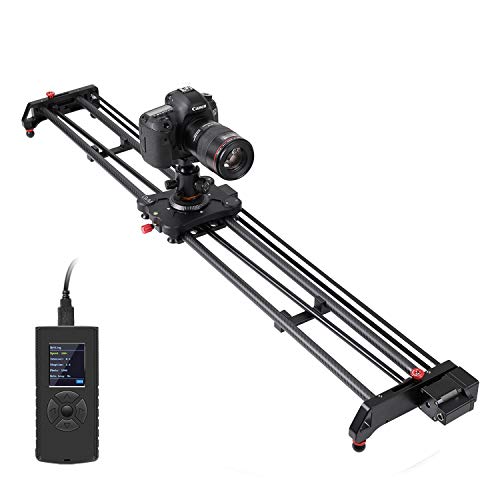
- 48-inch carbon-fiber travel length
- Programmable motion and automatic looping
- Supports tracking, time lapse, and panoramas
Best For: Extended motion shots and time-lapse production
Best Portable Manual Slider
Zecti 16-Inch Carbon Fiber Camera Slider

- Lightweight 1.3-pound travel-friendly design
- Adjustable legs and bubble level
- Works horizontally, vertically, or at an angle
Best For: Travel filmmaking and lightweight camera setups
Best App-Controlled Slider
NEEWER ER1 31.5-Inch Motorized Slider

- App, manual, video, and time-lapse control
- Silent motor with included 4400mAh battery
- Supports horizontal loads up to 11 pounds
Best For: Programmable creator, product, and time-lapse videos
Best Heavy-Duty Manual Slider
Fotodiox Pro SlideCam 800 32-Inch

- 32-inch ball-bearing track system
- Supports horizontal and vertical use
- Adjustable legs and multiple tripod threads
Best For: Stable movement with heavier camera systems
Best Advanced Motorized Slider

- Eight-point programmable motion paths
- AI face and object tracking
- Quiet, stabilized multi-mode movement
Best For: Automated cinematic, product, and time-lapse shots
Best Compact Manual Dolly
NEEWER SD001 Camera Slider Dolly

- Linear and circular wheel movement
- Includes ball head and phone clamp
- Lightweight 220g tabletop design
Best For: Portable smartphone, product, and tabletop filming
Best Long-Rail Motorized Slider
GVM 48-Inch Carbon Fiber Slider

- 48-inch motorized carbon-fiber rail
- App-controlled tracking and time-lapse modes
- Supports horizontal, vertical, and 45-degree setups
Best For: Long tracking moves and tripod-based production
Best Portable Rail Slider
16-Inch Carbon Fiber Camera Slider

- Quiet four-bearing movement
- Adjustable legs and bubble level
- Includes phone and action-camera mounts
Best For: Lightweight outdoor and tabletop filmmaking setups
Best Long-Travel Motorized Slider
27-Inch GVM Motorized Camera Slider

- 27-inch rail for longer camera moves
- Time-lapse and round-trip modes
- Works on the ground or with a tripod
Best For: Automated interviews, time-lapses, and extended tracking shots
Best Long-Range Motorized Slider – GVM Great Video Maker 48-Inch Motorized Slider
For filmmakers who need extended camera movement, this 48-inch GVM motorized slider is a versatile camera slider for filmmaking. It supports automatic round trips, time-lapse, panoramic, and tracking shots, while also allowing manual operation.
Best For: Long tracking shots, time-lapse sequences, and panoramic video work with compatible cameras up to 5 kg.
Pros:
- Offers adjustable speed, interval, stop time, torque, start and end points, and automatic looping.
- Supports manual and motorized operation, plus tracking and 120-degree panoramic shooting.
- Carbon-fiber construction, adjustable feet, multiple mounting threads, battery, cables, remote, and carrying bag are included.
Cons:
- At 48 inches long and 11.8 pounds, it is less portable than shorter sliders.
- It is not water resistant.
The GVM stands out when smooth, programmable movement and a long travel distance matter more than compact portability. Its extensive controls and included accessories make it a strong option for planned motion shots.
Best Portable Manual Slider – Zecti 16-Inch Carbon Fiber Camera Slider
The Zecti is a compact manual camera slider for filmmaking, designed for creators who want portable camera movement without a motor or complex controls. Its 16-inch carbon-fiber rail can be used on a surface or mounted to a tripod.
Best For: Travel filmmakers, lightweight DSLR or mirrorless setups, and straightforward horizontal, vertical, or angled shots.
Pros:
- Lightweight 1.3-pound design and included carrying bag are convenient for travel.
- Four precision bearings and a double interior carbon-fiber rail system support smooth movement.
- Adjustable legs, non-skid feet, bubble level, and multiple 1/4-inch and 3/8-inch mounting holes improve setup flexibility.
Cons:
- The 16-inch travel length is limited compared with longer sliders.
- The supplied note warns that overtightened screws can cause noise or rough movement.
- The phone holder is not included.
This slider is a practical choice when packability and simple manual control are priorities. Users should check the carriage tension during setup to help maintain quiet, smooth movement.
Best App-Controlled Slider – NEEWER ER1 31.5-Inch Motorized Slider
The NEEWER ER1 combines app-based control with motorized movement, making it a flexible camera slider for filmmaking, product videos, and time-lapse work. Its 31.5-inch carbon-fiber rail supports horizontal movement and tilt shooting up to 45 degrees.
Best For: Content creators who want programmable motion, app control, and a versatile slider for video or time-lapse sequences.
Pros:
- Supports app control, manual operation, video mode, and time-lapse settings.
- Silent stepper motor and included 4400mAh NP-F750 battery support extended shooting.
- Handles up to 11 pounds horizontally and includes 1/4-inch and 3/8-inch tripod threads.
Cons:
- The optional 2.4G remote is not included.
- A charger is not included according to the product details.
- Minor shake may occur during macro photography.
With app control, programmable timing, and multiple shooting angles, the ER1 offers broad creative control in a mid-length format. It is best suited to users comfortable managing battery and remote-control accessories separately.
Best Heavy-Duty Manual Slider – Fotodiox Pro SlideCam 800 32-Inch
The Fotodiox Pro SlideCam 800 is a sturdy manual camera slider for filmmaking that emphasizes mechanical stability and smooth ball-bearing movement. Its 32-inch track can be used horizontally or vertically and supports tripod or flat-surface setups.
Best For: Filmmakers using heavier camera systems who need stable, mechanically controlled movement and flexible mounting options.
Pros:
- Ball-bearing slide mechanism and double-layer anodized aluminum platform provide smooth, supported movement.
- Adjustable legs, non-skid feet, and a bubble level help with alignment on flat surfaces.
- Multiple 1/4-20 and 3/8-inch mounting holes support tripod configurations, and a carrying case is included.
Cons:
- At 5 pounds, it is heavier than compact carbon-fiber manual sliders.
- It uses manual operation rather than motorized movement or app control.
- It is not water resistant.
The SlideCam 800 is a sensible pick for controlled, stable camera movement with larger setups. Its aluminum construction and ball-bearing carriage favor durability and support over the lightest possible travel kit.
Best Advanced Motorized Slider – IFOOTAGE Shark Nano II
For filmmakers seeking a highly automated camera slider for filmmaking, the IFOOTAGE Shark Nano II combines multi-axis control, subject tracking, and quiet motorized movement in a 26-inch design. Its touchscreen and app controls make it suitable for repeatable shots and more complex motion paths.
Best For: Cinematic tracking shots, time-lapses, product videos, interviews, and crews that want AI-assisted motion control.
Pros:
- Supports up to eight customizable motion points through the IPS touchscreen or Moco app.
- AI face and object tracking helps keep subjects centered.
- Quiet brushless motor and stabilization algorithms are useful for recording sound and close-up work.
- Offers time-lapse, stop-motion, video, macro, and panorama modes.
Cons:
- The 26-inch travel length is shorter than the 48-inch GVM option.
- Its advanced controls may be more than needed for simple manual sliding shots.
- Full shooting flexibility may require compatible DJI equipment or an optional battery grip.
The Nano II is the most feature-rich choice here for filmmakers who value repeatable, automated movement and subject tracking. It is particularly compelling for demanding cinematic, macro, and product-shoot workflows.
Best Compact Manual Dolly – NEEWER SD001 Camera Slider Dolly
The NEEWER SD001 is a pocket-sized manual alternative for filmmakers who need a portable camera slider for filmmaking. Its four-wheel design supports straight or circular movement, while the included ball head and phone clamp make it practical for tabletop, smartphone, and lightweight-camera shots.
Best For: Tabletop videos, product shots, smartphone content, compact cameras, and portable panoramic moves.
Pros:
- Wheels can be adjusted for linear or circular movement.
- Soft rubber wheel rings provide smooth, quiet motion across floors, tables, and sliders.
- Included ball head offers 360-degree rotation and 90-degree tilt.
- Compact 220g aluminum-alloy design is easy to carry outdoors.
Cons:
- It is manual rather than motorized, so it does not provide automated repeatable moves.
- Not suitable for telephoto lenses.
- Action-camera adapter is sold separately.
The SD001 is best viewed as a flexible tabletop dolly rather than a full-length rail slider. Its small size, phone support, and circular movement make it a convenient choice for creators who prioritize portability over motorized precision.
Best Long-Rail Motorized Slider – GVM 48-Inch Carbon Fiber Slider
The GVM 48-inch motorized slider gives filmmakers a longer travel range for tracking and panoramic shots. As a camera slider for filmmaking, it combines carbon-fiber construction, app control, adjustable legs, and multiple shooting modes for more configurable studio or location setups.
Best For: Longer tracking moves, time-lapse work, panoramic shooting, and filmmakers using tripod-supported horizontal, vertical, or 45-degree setups.
Pros:
- Its 48-inch rail provides more travel than the 26-inch IFOOTAGE model.
- App control supports tracking, panoramic, time-lapse, and video capture modes.
- Multiple 1/4-inch and 3/8-inch ports support varied tripod configurations.
- Includes adjustable legs, six shutter-release cables, an extension cable, and a carry bag.
Cons:
- At 4kg, it is substantially less portable than the compact NEEWER dolly.
- Battery life is listed at approximately two hours.
- The slider is not water resistant.
The GVM is a strong fit when a long motorized travel distance matters more than minimal size. Its app-based controls and mounting options make it versatile, though the 120cm rail and 4kg weight favor planned setups over quick handheld-style production.
Best Motorized Dolly – Wireless Video Camera Dolly
If you want a compact camera slider for filmmaking with remote-controlled movement, the NEEWER DL100 is a practical choice for lightweight camera, phone, and action-camera setups. Its three adjustable speeds, reversible direction, and wheel-angle adjustment support both straight and circular tracking shots.
Best For: Filmmakers who need portable, remote-controlled dolly movement for cameras, smartphones, or action cameras.
Pros:
- Wireless remote changes speed, direction, or pauses movement from up to 6 meters away.
- Three speeds range from 1.4 to 3.0 cm/s for controlled motion.
- Adjustable wheels support straight-line and circular routes.
- Built-in 1800mAh battery provides up to six hours of service time.
Cons:
- Maximum recommended load is 6.6 pounds, so larger cinema rigs may not be suitable.
- It is not water resistant.
- Camera, phone, and action-camera accessories are not included.
The DL100 stands out when portability and repeatable motorized movement matter more than a long physical rail. Its compact design and remote control make it useful for tabletop scenes, product videos, and creative orbiting shots.
Best Portable Rail Slider – 16-Inch Carbon Fiber Camera Slider
The NEEWER CS1M is a compact camera slider for filmmaking built around a 16-inch carbon-fiber and aluminum rail. Its four bearings provide quiet movement, while adjustable legs, a bubble level, and multiple mounting threads make it adaptable for tabletop, tripod, horizontal, vertical, and 45-degree setups.
Best For: Outdoor creators and filmmakers who want a lightweight, quiet slider for cameras, phones, or action cameras.
Pros:
- Four precision bearings provide smooth, noiseless sliding.
- Adjustable legs elevate from 2 to 5 cm and help balance uneven surfaces.
- Supports horizontal, vertical, and 45-degree shooting.
- Includes a 360-degree ball head, phone clamp, and action-camera mount.
Cons:
- Horizontal load capacity is 4.4 pounds, with lower limits for tilted or vertical use.
- The 16-inch rail offers less travel than longer sliders.
- It is not water resistant.
At 615 grams, the CS1M is well suited to mobile production where packing space matters. The included mounting accessories broaden its usefulness, though heavier cameras and long tracking moves may call for a larger slider.
Best Long-Travel Motorized Slider – 27-Inch GVM Motorized Camera Slider
For longer camera moves, the GVM G5-GVM-GT60 provides a 27-inch motorized rail for filmmaking, interviews, and photography. It supports time-lapse, standard video, and automatic round-trip shooting, with adjustable feet and mounting points for ground or tripod use.
Best For: Filmmakers who need longer automated tracking moves, time-lapses, or repeatable round-trip motion.
Pros:
- 27-inch rail provides more travel than compact sliders.
- Supports time-lapse, video, and automatic round-trip shooting modes.
- Can be used on the ground or mounted to a tripod.
- Supports horizontal, vertical, and 45-degree shooting.
Cons:
- At 2.36 kg, it is substantially heavier than the compact NEEWER rail slider.
- Maximum recommended load is 2.5 kg.
- It is not water resistant.
The GVM is the better fit when travel distance and automated repeatability are priorities. Its larger aluminum design is less convenient to carry, but the longer rail and multiple shooting modes make it more capable for interviews, planned camera moves, and time-lapse work.
How We Picked the Best Camera Slider for Filmmaking
We evaluated these sliders by looking at the factors that matter most on set: travel length, motion control, payload suitability, portability, setup complexity, and the types of cameras and accessories each design can accommodate. The selection includes manual rails for straightforward moves, motorized sliders for repeatable shots, and compact dolly systems for smaller cameras, phones, and action cameras.
We also considered useful features such as round-trip movement, time-lapse support, app control, panoramic rotation, ball heads, phone clamps, carbon-fiber construction, and adjustable wheels. Always confirm the manufacturer’s payload guidance and mounting requirements before using a heavier camera or lens.
Quick Comparison
- Best for long, automated moves: The 48-inch GVM motorized options provide more room for extended tracking shots and programmed movement.
- Best for portability: The 16-inch Zecti and NEEWER carbon-fiber sliders are easier to pack for travel and small-location work.
- Best for app-based control: The NEEWER ER1 and GVM professional carbon-fiber model offer more convenient control for repeatable motion.
- Best for simple manual operation: The Fotodiox Pro SlideCam provides a straightforward rail-and-bearing approach without motor controls.
- Best for compact cameras and phones: The NEEWER dolly systems include accessories intended for lighter setups.
Key Buying Factors for a Camera Slider for Filmmaking
Length and Usable Travel
Short sliders are easier to transport and work well on desks, tabletop scenes, and tight interiors. Longer 31.5- to 48-inch models create broader movement but need more room, stronger support, and additional setup time.
Manual or Motorized Movement
Manual sliders are quick to operate and useful for responsive, human-controlled moves. Motorized models are preferable for time-lapses, product shots, repeated takes, and slow movements that need consistent speed.
Payload and Stability
Check compatibility with your camera body, lens, cage, microphone, monitor, and other accessories—not just the camera’s bare weight. A stable tripod or support system is essential, especially with long rails and heavier rigs.
Control Features and Accessories
App control, adjustable speed, round-trip shooting, panoramic rotation, and time-lapse functions can expand creative options. Ball heads, phone clamps, and action-camera mounts are useful when one slider must serve multiple types of equipment.
Build and Portability
Carbon fiber can reduce carrying weight, while aluminum rails may offer a sturdy, practical setup. Consider folded dimensions, included supports, power requirements, and how quickly the slider can be leveled and packed away.
Who Should Buy Which Camera Slider for Filmmaking?
Choose a compact manual slider if you primarily shoot tabletop videos, travel content, phones, or lightweight mirrorless cameras and want minimal setup. Choose a motorized slider for time-lapse work, product demonstrations, repeatable takes, or slow cinematic movement. Choose a longer 48-inch model when you have adequate space and need extended tracking distance. Choose a wheeled dolly for fast repositioning on smooth surfaces and lightweight camera setups.
For most buyers, the best Camera Slider for Filmmaking is the one that matches the camera payload, available shooting space, and desired level of automation. Prioritize stable support and reliable movement over maximum length or the largest feature list.