
A capable field monitor can make mirrorless-camera video easier to frame, focus, and expose—especially when the built-in screen is small, dim, or difficult to view from an awkward angle.
We’ve selected 10 monitors with different screen sizes, brightness levels, monitoring tools, and connectivity options so you can find a practical match for handheld shooting, studio work, interviews, or outdoor production.
Best 10 Camera Field Monitors for Mirrorless Cameras Picks for 2026
Bright-Daylight Control
NEEWER F700 7-inch 2000nit Monitor

- 2000-nit 1080p touchscreen for bright locations
- 4K HDMI loop-through and headphone monitoring
- Scopes, custom LUTs, and flexible power options
Best For: Outdoor shoots and advanced on-set monitoring
Lightweight Scope Access
Portkeys PT5 II 5-inch Touch Monitor

- Compact Full HD touchscreen with 178-degree viewing
- 4K30P HDMI input/output
- Waveforms, false color, peaking, and 3D LUT tools
Best For: Small mirrorless rigs and lightweight setups
Modern Mirrorless Workflow

- 1200-nit screen with 4K30P HDMI support
- Built-in battery, USB-C power, and five-level cooling
- Screenshot overlays, LUT import, and professional scopes
Best For: Newer mirrorless workflows and repeatable framing
Simple Outdoor Framing

- 1000-nit matte screen with included sun hood
- 4K30p HDMI and headphone audio output
- Lightweight body with included NP-F550 battery
Best For: Outdoor framing and straightforward mobile rigs
Bright Outdoor Pick

- 2000-nit touchscreen with automatic backlight control
- 4K HDMI loop in/out and professional monitoring tools
- Multiple power options, including NP-F and USB-C
Best For: Outdoor filmmakers needing a large, highly visible display
Lightweight Creator Choice
FEELWORLD F5 Prox 5.5-inch Monitor

- 1600-nit screen for outdoor visibility
- Waveform, histogram, false color, and focus peaking
- Mounts to rigs, gimbals, tripods, and handheld setups
Best For: Mobile creators and gimbal-based shooting
Best Included Kit

- 1200-nit touchscreen with 4K HDMI loop in/out
- Includes battery, sunshade, cables, adapter, and carry case
- Provides waveform, vectorscope, histogram, false color, and focus tools
Best For: Shooters wanting a complete, ready-to-use monitor package
Best Bright Compact Monitor

- 1200-nit Full HD IPS display for outdoor visibility
- Waveform, vectorscope, histogram, focus assist, and LUT preview
- 204g body with NP-F or USB-C power and camera power output
Best For: Outdoor and mobile mirrorless camera rigs
Best Large Touchscreen Monitor
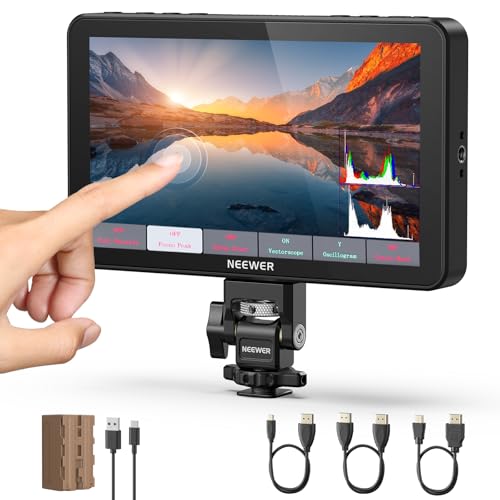
- 2000-nit touchscreen with automatic and manual backlight control
- 4K HDMI loop-through plus headphone audio monitoring
- Extensive scopes, custom 3D LUT support, and included 5200mAh battery
Best For: Advanced outdoor and production monitoring
Best Beginner Monitor

- Full HD IPS display with 4K HDMI input/output up to 4K at 30Hz
- Waveform, false color, focus assist, histogram, and 3D LUT support
- Multiple power options and flexible camera, tripod, and gimbal mounting
Best For: Beginner creators and indoor video setups
Bright-Daylight Control – NEEWER F700 7-inch 2000nit Monitor
For creators comparing camera field monitors for mirrorless cameras, the NEEWER F700 stands out when outdoor visibility and detailed monitoring are priorities. Its 7-inch 1920×1080 touchscreen reaches 2000 nits, while HDMI loop-through, monitoring scopes, and LUT support add useful on-set control.
Best For: Outdoor mirrorless shoots, HDR or LOG monitoring, and productions needing a large, very bright display.
Pros:
- 2000-nit IPS touchscreen with automatic or manual backlight adjustment.
- Supports HDMI input and loop output up to 4K, plus headphone audio monitoring.
- Includes waveform, vectorscope, false color, zebras, focus peaking, and other professional tools.
- Supports up to 60 custom 3D LUT files and multiple power options.
Cons:
- The monitor is heavier with two batteries installed.
- NP-F batteries and an SD card for LUT or firmware workflows may require separate preparation.
- Built-in fans may be noticeable in quiet recording environments.
The F700 is a feature-rich choice when brightness and scope access matter more than minimal weight. Its 7-inch screen and flexible power design suit demanding field rigs, although smaller setups may find it more monitor than they need.
Lightweight Scope Access – Portkeys PT5 II 5-inch Touch Monitor
The Portkeys PT5 II is a compact option for shoppers evaluating camera field monitors for mirrorless cameras. Its 5-inch Full HD touchscreen keeps a rig light while providing 4K30P input/output, waveform tools, 3D LUT features, and a wide 178-degree viewing angle.
Best For: Lightweight gimbals, compact mirrorless rigs, and shooters who want waveform and LUT tools without a large monitor.
Pros:
- Compact 5-inch 1920×1080 display with a 178-degree viewing angle.
- Offers 4K30P HDMI input/output and a wide color gamut.
- Provides luma and RGB waveform displays, histogram, false color, peaking, and 3D LUT functions.
- Lightweight design is suited to portable camera builds.
Cons:
- Battery is not included.
- The smaller screen provides less viewing area than 6- or 7-inch alternatives.
- Its listed display resolution is Full HD rather than 4K.
The PT5 II makes a sensible tradeoff for mobility: it delivers serious exposure and focus aids in a small package. Choose it when keeping camera weight and footprint down is more important than maximum screen size or brightness.
Modern Mirrorless Workflow – FEELWORLD P6XL 6-inch Monitor
The FEELWORLD P6XL is designed around newer mirrorless and compact cinema workflows, making it a strong contender among camera field monitors for mirrorless cameras. It combines a 1200-nit 6-inch touchscreen with supported HDMI formats up to 4K30P, built-in battery power, adjustable cooling, and shot-matching overlays.
Best For: Current mirrorless cameras, solo operators, long recording sessions, and productions that need repeatable framing.
Pros:
- Supports commonly used HDMI formats up to 4K30P and 1080P60P.
- 1200-nit touchscreen with touch gestures and a physical control wheel.
- Built-in 22.2Wh battery and USB-C charging support reduce reliance on external NP-F batteries.
- Includes adjustable five-level fan cooling, custom LUT import, scopes, and screenshot overlay tools.
Cons:
- Maximum-brightness runtime is approximately two hours with the fan at level 5.
- USB-C charging requires a compatible power source and supported input conditions.
- Camera HDMI output must be set to a supported resolution and frame rate.
The P6XL is particularly practical for creators who work alone or repeat setups across multiple takes. Its integrated power, cooling control, and reference-frame overlay make it more workflow-focused than a basic viewing monitor.
Simple Outdoor Framing – Portkeys HD7H 7-inch Monitor
For buyers seeking straightforward camera field monitors for mirrorless cameras, the Portkeys HD7H offers a large 7-inch matte display with 1000-nit brightness. It adds a sun hood, 4K30p HDMI support, core exposure and focus tools, and a battery in the listed package.
Best For: Outdoor DSLR or mirrorless shooting, budget-conscious rigs, and operators who prefer a large matte screen.
Pros:
- 1000-nit 7-inch matte screen with included sun hood to reduce reflections.
- Supports video up to 4K30p and provides a headphone output for audio monitoring.
- Includes histogram, false color, focus peaking, zoom, and anamorphic de-squeeze tools.
- Lightweight 278-gram design, three mounting-thread positions, and included NP-F550 battery.
Cons:
- The panel is listed as HD rather than a native 1920×1080 display.
- Its 1000-nit brightness is lower than the brightest monitor in this group.
- Advanced LUT and waveform features are not listed among the supplied specifications.
The HD7H is a practical, uncomplicated choice for outdoor framing and basic exposure or focus checks. Its matte screen, hood, low weight, and included battery make it appealing for mobile rigs, while advanced monitoring needs may point toward a more feature-heavy model.
Bright Outdoor Pick – NEEWER F700 7-inch Monitor
For camera field monitors for mirrorless cameras, the NEEWER F700 stands out with a large 7-inch 2000-nit touchscreen. Its automatic backlight control is designed to keep the display visible in bright sunlight while also dimming it in darker conditions.
Best For: Outdoor filmmakers who want a highly visible, large monitoring screen with extensive exposure and focus tools.
Pros:
- 2000-nit 1920×1080 IPS touchscreen with automatic brightness adjustment
- 4K HDMI loop input and output plus headphone audio monitoring
- Includes professional tools such as waveform, vectorscope, false color, zebras, histogram, and focus peaking
- Accepts NP-F batteries, DC power, or USB-C charging
Cons:
- NP-F battery and DC cable are not included
- At 7 inches and 1.6 pounds, it may be less convenient for compact or gimbal setups
- Cooling fans may add operating noise
The F700 is the strongest choice here when sunlight visibility and screen size take priority. Its LUT support, shortcut buttons, and broad power options also suit more involved field-production workflows.
Lightweight Creator Choice – FEELWORLD F5 Prox 5.5-inch Monitor
The FEELWORLD F5 PROX is a practical option among camera field monitors for mirrorless cameras, offering a 5.5-inch 1600-nit display for checking focus, exposure, and framing. Its compact design is intended for camera rigs, gimbals, tripods, and handheld setups.
Best For: Photographers, vloggers, and videographers who need a bright external screen that remains balanced on mobile camera setups.
Pros:
- 1600-nit display for clearer outdoor monitoring
- Focus peaking, waveform, histogram, and false color assist with exposure and focus
- Supports LUT preview for monitoring a Log shooting look
- Designed for DSLR, mirrorless, and cinema cameras with flexible mounting
Cons:
- Smaller screen than the NEEWER F700
- The supplied notes do not specify HDMI loop-through or included mounting accessories
- Its listed package weight is 2.82 pounds, which may be more than expected for a compact monitor setup
The F5 PROX focuses on the essentials: a bright screen, useful exposure and focus aids, and easy integration with common camera support systems. It is a sensible fit for creators who value portability and fast setup.
Best Included Kit – VILTROX DC-550 Pro II
The VILTROX DC-550 Pro II combines a 5.5-inch 1200-nit touchscreen with 4K HDMI input and output, making it a well-equipped choice among camera field monitors for mirrorless cameras. It also includes a sunshade, NP-F550 battery, cables, cold shoe adapter, and carry case.
Best For: Mirrorless and DSLR shooters who want a ready-to-use monitoring kit with useful accessories included.
Pros:
- 1200-nit 1920×1080 IPS touchscreen with REC-709 color calibration
- 4K HDMI loop in/out and a 3.5mm headphone jack
- Includes waveform, vectorscope, histogram, false color, and focus-assist functions
- Package includes an NP-F550 battery, sunshade, cables, adapter, case, and one-year replacement service
Cons:
- Its 1200-nit brightness is lower than the other two monitors
- The 5.5-inch display provides less viewing area than a 7-inch monitor
- Custom LUTs require importing through an SD card
The DC-550 Pro II is particularly appealing when included accessories matter. It delivers core professional monitoring features while reducing the need to purchase a battery, sunshade, cables, and carrying case separately.
Best Bright Compact Monitor – FEELWORLD FW568 PRO 6-inch
For creators comparing camera field monitors for mirrorless cameras, the FEELWORLD FW568 PRO combines a compact 6-inch Full HD display with strong outdoor visibility. Its 1200-nit brightness, 4K HDMI input/output, and exposure and focus tools make it a practical choice for mobile production.
Best For: Outdoor filmmakers, vloggers, wedding shooters, and gimbal users who need a bright, lightweight monitor.
Pros:
- 1200-nit screen remains easier to see in direct sunlight.
- Waveform, vectorscope, RGB histogram, focus assist, and LUT preview support more controlled shooting.
- Supports NP-F battery or USB-C power and can provide 8.4V output to a compatible camera.
- Lightweight 204g design and 1/4-inch mounting threads suit rigs and stabilizers.
Cons:
- The 6-inch screen is smaller than some 7-inch field monitors.
- Its feature set may be more than beginners need for basic framing.
The FW568 PRO is a well-rounded option when sunlight readability and portability matter most. It offers professional monitoring aids without adding much weight to a mirrorless camera setup.
Best Large Touchscreen Monitor – NEEWER F700 7-inch
The NEEWER F700 is a feature-rich choice among camera field monitors for mirrorless cameras, with a large 7-inch touchscreen, 2000-nit brightness, and 4K HDMI loop-through. It is suited to demanding shoots where detailed viewing, monitoring tools, and flexible controls are priorities.
Best For: Filmmakers and production teams working outdoors or using advanced exposure, focus, HDR, and LUT workflows.
Pros:
- 2000-nit IPS touchscreen with manual or automatic backlight control improves visibility in changing light.
- Supports 4K HDMI loop in/out and headphone monitoring through a 3.5mm jack.
- Includes waveform, vectorscope, false color, zebras, histogram, HDR, peak focus, and audio bar tools.
- Accepts custom 3D LUT uploads and includes a 5200mAh NP-F750 battery.
Cons:
- At 654g with the battery, it is substantially heavier than compact monitor options.
- Cooling fans may be undesirable for especially noise-sensitive recording setups.
- The advanced controls may be excessive for simple framing and focus checks.
The F700 stands out for bright outdoor work and professional monitoring flexibility. Choose it when its larger touchscreen, loop-through connectivity, and extensive toolset justify the added size and weight.
Best Beginner Monitor – FEELWORLD S55 V3 6-inch
The FEELWORLD S55 V3 is a straightforward entry point for shoppers seeking camera field monitors for mirrorless cameras. Its 6-inch Full HD IPS screen, 4K HDMI input/output, and built-in exposure and focus aids provide a larger, more informative view for everyday video work.
Best For: Beginner videographers, vloggers, interview creators, livestreamers, and indoor recording setups.
Pros:
- Full HD 6-inch IPS display provides a clearer monitoring view than a camera’s built-in screen.
- Waveform, vectorscope, RGB histogram, false color, focus assist, and 3D LUT support aid exposure and focus decisions.
- Works with DSLR, mirrorless cameras, and camcorders through 4K HDMI input/output up to 4K at 30Hz.
- Supports Type-C, DC, NP-F, and LP-E6 power, with 1/4-inch and hot-shoe mounting options.
Cons:
- Its listed 450-nit brightness is less suited to direct sunlight than brighter alternatives.
- The monitor is better matched to indoor use, even though the included sun hood helps on location.
The S55 V3 offers a useful balance of monitoring features and accessible setup. It is a sensible pick for beginners who want better framing, focus, and exposure control without moving to a larger 7-inch monitor.
How We Picked the Best Camera Field Monitors for Mirrorless Cameras
We focused on the features that have the greatest effect on real-world monitoring: screen brightness, resolution, HDMI compatibility, touchscreen or shortcut control, focus-assist tools, LUT support, power options, and physical size. The selection includes 5- to 7-inch displays, so both portability and viewing comfort are represented.
We also considered whether a monitor is better suited to daylight work, compact rigs, extended shoots, or basic framing and playback. Because listed specifications can vary by seller or production revision, confirm current inputs, outputs, batteries, and included accessories before purchasing.
Quick Comparison
- Best for bright outdoor shooting: Look for a monitor rated around 1,000 nits or more, preferably with a sun hood.
- Best for compact rigs: A 5- or 5.5-inch monitor keeps weight and bulk down.
- Best for comfortable viewing: A 6- or 7-inch screen offers a larger image for framing and focus checks.
- Best for advanced monitoring: Prioritize 3D LUT support, peaking, false color, zebra, histogram, and waveform tools.
- Best for longer sessions: Choose a model with a replaceable NP-F battery or another readily available power system.
Key Buying Factors for Camera Field Monitors for Mirrorless Cameras
Brightness and Screen Size
Brightness matters most outdoors, where reflections can make a low-output display difficult to use. Larger screens improve composition and manual-focus checks but add weight to a compact mirrorless setup. A sun hood can help, although it does not replace high brightness in direct sunlight.
Resolution and HDMI Compatibility
A 1920×1080 panel is generally sufficient for monitoring 4K camera output while keeping cost and power use reasonable. Check whether the monitor accepts your camera’s HDMI format, including resolution, frame rate, and signal type. HDMI loop-through is useful when sending the feed to a recorder or second display.
Monitoring Tools and Controls
Focus peaking, punch-in magnification, zebras, false color, waveform, histogram, and 3D LUT loading can provide more dependable exposure and focus decisions than the camera screen alone. Touch controls are convenient, while physical shortcut buttons may be faster when operating with gloves or without looking away from the scene.
Power, Mounting, and Durability
Confirm battery compatibility, runtime expectations, charging options, and whether the monitor can run from an external power source. Also check the mounting thread, included articulating arm or shoe mount, weight, and cable clearance. A monitor that is bright but poorly balanced can make a small rig uncomfortable.
Who Should Buy Which Camera Field Monitors for Mirrorless Cameras?
Choose a compact 5-inch model if you primarily shoot handheld, travel, or use a lightweight gimbal. A 5.5- or 6-inch monitor is a strong middle ground for general mirrorless video, while a 7-inch option makes sense for tripod work, interviews, studio setups, and teams that need easier shared viewing.
Outdoor creators should prioritize the brightest display they can comfortably power. Solo shooters who rely on manual focus should favor peaking and magnification. Shooters working with log footage should look for LUT support and exposure tools. If your needs are limited to a larger, easier-to-see image, prioritize compatibility, weight, screen quality, and battery convenience over advanced features.