
Camera extension tubes make compatible lenses focus much closer by moving them farther from the sensor, offering an affordable way to explore macro photography without buying a dedicated macro lens.
This roundup compares 10 options across Canon, Sony, Nikon, Fujifilm, and Micro Four Thirds systems, with attention to autofocus, electronic metering, mount compatibility, and extension length.
Best 10 Camera Extension Tubes for Macro Photography Picks for 2026
Versatile Canon Macro Kit
Fotodiox EF/EF-S Extension Tubes

- All-metal construction
- Multiple combinations for macro effects
- Manual focus and exposure control
Best For: Canon EOS users seeking a durable, flexible manual macro setup
Autofocus Sony Macro Set
Meike S-AF3A Sony Extension Tubes

- 10mm and 16mm tubes
- Autofocus support
- Works with APS-C and full-frame Sony E cameras
Best For: Sony E-mount photographers wanting flexible extension lengths and electronic support
Canon OEM Close-Up Option

- Eight electronic contacts
- Compatible with selected EF, EF-S, and TS-E lenses
- Includes caps and storage pouch
Best For: Canon EOS owners wanting a compact branded tube with lens communication
Flexible Sony E-Mount Choice
JJC Sony E Auto Focus Macro Tubes

- 10mm and 16mm tube options
- Autofocus and automatic exposure
- Aluminum and brass mounting components
Best For: Sony E-mount users wanting flexible close-up magnification with electronic support
Best MFT Value
Fotodiox Macro Extension Tube Set

- Three tubes for flexible combinations
- Fits compatible Olympus and Panasonic MFT cameras
- 24-month manufacturer warranty
Best For: Micro Four Thirds photographers using manual focus
Best Canon DSLR Flexibility
VILTROX DG-C Auto Focus Extension Tubes

- 12mm, 20mm, and 36mm tubes
- Preserves autofocus and automatic exposure
- Metal mounts with electronic contacts
Best For: Canon EF and EF-S DSLR users
Best Fujifilm X-Mount Pick
Fujifilm MCEX-11 Macro Extension Tube

- 11mm extension for Fujifilm X cameras
- Supports autofocus and automatic exposure
- Uses Super EBC coating
Best For: Fujifilm X-series photographers using XF lenses
Nikon AF Macro Starter Set
Extnp Auto Focus Extension Tubes

- 12mm, 20mm, and 36mm tubes
- For Nikon AF and AF-S DX/FX SLR cameras
- Use individually or in combinations
Best For: Nikon users exploring flexible macro magnification
Canon Single-Tube Value Pick

- 25mm extension for closer focusing
- Automatic focusing and metering passthrough
- Includes a one-year warranty
Best For: Canon EOS users wanting a simple macro upgrade
Canon Flexible Macro Kit
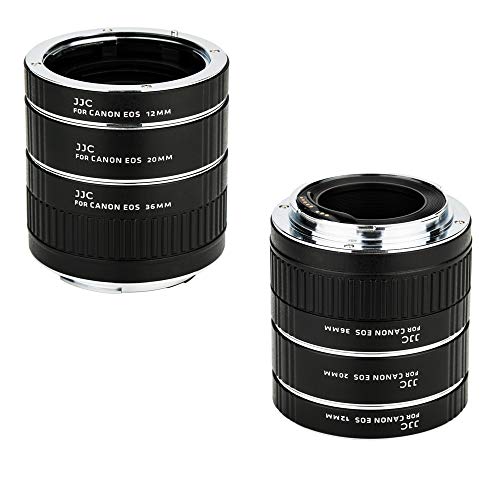
- 12mm, 20mm, and 36mm extensions
- Fits Canon EOS with EF and EF-S lenses
- Supports autofocus and auto exposure
Best For: Canon users seeking adjustable macro magnification
Versatile Canon Macro Kit – Fotodiox EF/EF-S Extension Tubes
For Canon shooters comparing camera extension tubes for macro photography, this Fotodiox set offers a straightforward way to shorten focusing distance without adding glass between the lens and camera. Its all-metal construction and multiple combinations give you flexibility for different macro effects, with manual focusing and exposure control.
Best For: Canon EOS users who want a durable, manually controlled extension-tube setup for experimenting with different macro magnifications.
Pros:
- Designed for Canon EF and EF-S mounts
- All-metal construction
- Multiple combinations support different macro effects
- Does not alter the optical quality of the attached lens
Cons:
- Manual focus and manual exposure may require more setup
- Not water resistant
This is a practical choice when build quality and configuration flexibility matter more than automated shooting assistance. Confirm your lens and camera compatibility before ordering.
Autofocus Sony Macro Set – Meike S-AF3A Sony Extension Tubes
The Meike S-AF3A is a useful option for Sony E/FE photographers looking for camera extension tubes for macro photography with electronic camera communication. Its 10mm and 16mm tubes can be used separately or together, while autofocus support and compatibility with Sony APS-C and full-frame cameras add convenience.
Best For: Sony E-mount users who want selectable extension lengths, autofocus support, and a compact set for photographing flowers, insects, and other small subjects.
Pros:
- Compatible with Sony E-mount APS-C and full-frame cameras
- 10mm and 16mm tubes work individually or together
- Supports autofocus and all shooting modes
- Metal bayonet construction with a portable design
Cons:
- Manual mode is recommended for direct shutter-speed control
- Requires exposure compensation
- Tube body is plastic and there is no image stabilization
With three usable extension combinations and electronic functionality, this Meike set balances flexibility with convenience. Manual exposure adjustments may still be necessary for consistent macro results.
Canon OEM Close-Up Option – Canon EF 12 II Extension Tube
The Canon EF 12 II is a compact choice among camera extension tubes for macro photography when you want an original Canon accessory with electronic lens communication. It shortens the lens’s focusing distance for higher-magnification close-ups and works with compatible EF, EF-S, and TS-E lenses.
Best For: Canon EOS owners seeking a single, compact extension tube with electronic contacts and broad compatibility across compatible Canon lens types.
Pros:
- Compatible with Canon EF-mount EOS cameras
- Eight electronic contacts maintain camera-and-lens communication
- Works with compatible EF-S, EF, and TS-E lenses
- Includes caps, pouch, and limited one-year warranty
Cons:
- Magnification varies according to the lens used
- Not compatible with several listed lenses, including the 15mm fisheye and MP-E 65mm
- Exposure control is manual
This Canon-made tube is a sensible fit for users who prefer a branded accessory and electronic contacts in a single 12mm-style close-up solution. Check the exclusion list carefully before purchase.
Flexible Sony E-Mount Choice – JJC Sony E Auto Focus Macro Tubes
For Sony mirrorless owners comparing camera extension tubes for macro photography, the JJC set provides 10mm and 16mm options that can be used independently or together. It supports autofocus and automatic exposure, although the manufacturer recommends manual focus or a tripod with a focusing rail for more controlled results.
Best For: Sony E-mount photographers who want adjustable extension lengths and automatic camera functions for close-up work.
Pros:
- Fits Sony E-mount mirrorless cameras and lenses
- 10mm and 16mm tubes can be combined
- Supports autofocus and automatic exposure
- Uses aluminum and brass mounting components
Cons:
- Manual focus is recommended after installation
- A tripod and focusing rail may be preferable for precise work
- Tube body is ABS plastic and the set is not water resistant
The JJC set is appealing for Sony users who want both extension-length flexibility and electronic automation. For maximum precision at high magnification, plan to use a stable support and manual focusing technique.
Best MFT Value – Fotodiox Macro Extension Tube Set
Fotodiox Macro Extension Tube Set for Extreme Close-up for Micro Four Thirds Cameras
Check Price On AmazonThe Fotodiox Macro Extension Tube Set is a flexible option for Micro Four Thirds photographers exploring camera extension tubes for macro photography. Its three tubes can be used individually or combined to create different close-up effects with compatible Olympus and Panasonic cameras.
Best For: Micro Four Thirds users who want a versatile manual-focus extension tube kit.
Pros:
- Includes three extension tubes for multiple combinations.
- Compatible with a broad range of Olympus PEN, OM-D, and Panasonic Lumix cameras listed by the manufacturer.
- Includes camera and lens coupling adapters.
- Backed by a 24-month manufacturer warranty.
Cons:
- Uses manual focus rather than autofocus.
- Compatibility is limited to Micro Four Thirds mounts.
- No water resistance is specified.
With its combination-friendly design and broad MFT compatibility, this kit suits photographers who are comfortable focusing manually and want an adaptable entry into close-up work.
Best Canon DSLR Flexibility – VILTROX DG-C Auto Focus Extension Tubes
The VILTROX DG-C is a practical choice for Canon users comparing camera extension tubes for macro photography. Its 12mm, 20mm, and 36mm tubes support individual or combined use while retaining electronic communication for autofocus and automatic exposure with compatible EF and EF-S lenses.
Best For: Canon DSLR photographers who want adjustable magnification with autofocus and automatic exposure support.
Pros:
- Includes 12mm, 20mm, and 36mm tubes for varied magnification levels.
- Maintains electronic communication between the camera and lens.
- Supports autofocus and automatic exposure functions.
- Uses precision-engineered metal mounts and electronic contacts.
Cons:
- Designed for Canon EF and EF-S systems rather than mirrorless mounts.
- Does not include image stabilization.
- Coverage is limited to compatible Canon DSLR combinations.
This set stands out for Canon DSLR owners who want the control of interchangeable tube lengths without giving up the convenience of autofocus and automatic exposure.
Best Fujifilm X-Mount Pick – Fujifilm MCEX-11 Macro Extension Tube
The Fujifilm MCEX-11 is a straightforward single-tube option for Fujifilm photographers shopping for camera extension tubes for macro photography. Built for Fujifilm X-series cameras and XF lenses, it supports autofocus and automatic exposure while adding 11mm of extension.
Best For: Fujifilm X-system photographers seeking a dedicated, autofocus-compatible macro accessory.
Pros:
- Designed for Fujifilm X-mount cameras and compatible XF lenses.
- Supports autofocus and automatic exposure.
- Uses Fujifilm Super EBC coating.
- Compatible with listed X-series models, including the X-Pro1, X-T1, and X-E2.
Cons:
- Provides one 11mm tube rather than a multi-tube set.
- Compatibility is limited to the Fujifilm X system.
- No water resistance is specified.
The MCEX-11 is a good fit for X-mount owners who prefer a purpose-built Fujifilm accessory and want autofocus and automatic exposure support in a compact setup.
Nikon AF Macro Starter Set – Extnp Auto Focus Extension Tubes
For Nikon DSLR owners comparing camera extension tubes for macro photography, this three-piece set offers 12mm, 20mm, and 36mm tubes that can be used individually or combined. It is designed to turn a compatible Nikon lens into a closer-focusing macro setup while retaining autofocus and exposure functionality, though the very short working distance requires careful technique.
Best For: Nikon AF and AF-S DX/FX SLR users who want flexible tube lengths for experimenting with small-subject photography.
Pros:
- Includes 12mm, 20mm, and 36mm tubes for adjustable magnification.
- Compatible with a broad range of Nikon AF and AF-S DX/FX SLR cameras.
- Supports autofocus when used at an appropriate 1–3cm focusing distance.
Cons:
- Autofocusing can be difficult when all three tubes are combined.
- The close 1–3cm focusing distance may be challenging for moving subjects.
This set is a versatile entry point for Nikon users who value multiple extension options. For the most reliable results, use manual focus or a longer focal-length lens when stacking all three tubes.
Canon Single-Tube Value Pick – Movo/Kooka AF 25mm Macro Tube
This 25mm Movo/Kooka tube is a straightforward option for Canon EOS owners shopping for camera extension tubes for macro photography. It enables closer focusing while preserving automatic focusing and metering passthrough, making it a simple way to add macro capability without purchasing a dedicated macro lens.
Best For: Canon EOS DSLR users who prefer one fixed-length tube and automatic focusing support.
Pros:
- 25mm extension enables closer focusing for macro work.
- Maintains autofocus and automatic metering passthrough.
- Includes a one-year warranty.
Cons:
- Provides only one extension length, limiting magnification choices.
- Uses an economy plastic mount.
Its single-tube design keeps the setup uncomplicated and affordable for Canon photographers testing macro photography. Choose it when convenience matters more than the adjustable focal reach of a multi-tube kit.
Canon Flexible Macro Kit – JJC EF/EF-S Auto Focus Tubes
For Canon photographers comparing camera extension tubes for macro photography, this JJC kit provides 12mm, 20mm, and 36mm extensions for flexible magnification. The tubes fit Canon EOS cameras with EF and EF-S lenses and support autofocus and auto exposure, although the manufacturer recommends manual focus or a tripod with a focusing rail for more dependable results.
Best For: Canon EOS users who want multiple extension lengths and broad compatibility with EF and EF-S lenses.
Pros:
- Three lengths can be used separately or combined.
- Supports full autofocus and auto exposure.
- Brass camera and lens mounts are paired with an ABS tube body.
Cons:
- Manual focus or tripod-assisted focusing is recommended after installation.
- The ABS tube body is not water resistant.
This kit offers more composition and magnification flexibility than a single extension tube. It is a practical match for Canon users willing to use controlled focusing techniques, especially when working from a tripod.
How We Picked the Best Camera Extension Tubes for Macro Photography
We focused on extension tubes that match the listed camera mounts and provide a practical path to closer focusing. The most important distinctions are electronic passthrough, extension length, construction, and whether the set includes multiple tube sizes for flexible magnification.
Autofocus-compatible models can preserve communication between the camera and lens, including automatic focusing, aperture control, and metering where supported. Manual tubes may cost less, but they require more hands-on control and may be less convenient in the field.
Quick Comparison
| Best For | What to Look For |
|---|---|
| Flexible magnification | A set with multiple tube lengths |
| Convenient shooting | Autofocus and electronic-contact passthrough |
| Native-system integration | A manufacturer-made tube for your camera mount |
| Budget macro experimentation | A simple compatible set with solid mounting |
| Maximum close-up effect | Longer extension, balanced against reduced working distance |
Key Buying Factors for Camera Extension Tubes for Macro Photography
Mount and Lens Compatibility
Verify both the camera mount and the lens mount before ordering. Canon EF and EF-S, Sony E and FE, Nikon F, Fujifilm X, and Micro Four Thirds are not interchangeable. An EF-S lens may also require a tube specifically designed to accommodate its rear projection.
Electronic Contacts
Electronic contacts are valuable when you want autofocus, camera-controlled aperture, and automatic metering. They do not guarantee fast or reliable autofocus at extreme magnification, so manual focusing may still be preferable for stationary subjects.
Extension Length and Working Distance
More extension generally produces greater magnification, but it also shortens the minimum focusing distance and can make lighting difficult. Multi-piece sets let you adjust the effect; a single 12mm, 20mm, 25mm, or 36mm tube is simpler and easier to predict.
Build and Handling
Look for secure bayonet mounts, accurately aligned contacts, and minimal play between the camera, tube, and lens. A sturdy tube matters especially with heavier lenses. Extension tubes add no optical elements, so image quality mainly depends on the attached lens and the stability of the setup.
Who Should Buy Which Camera Extension Tubes for Macro Photography?
Canon DSLR users should start by matching the tube to EF or EF-S lenses, then choose between a native Canon option and an autofocus-compatible third-party set. Sony E/FE photographers will benefit from a set with electronic passthrough, while Nikon users should confirm AF and AF-S compatibility with their specific body and lens combination.
Fujifilm and Micro Four Thirds photographers should prioritize system-specific fit and a tube length suited to their subjects. Choose a multi-tube kit if you photograph varied subjects such as flowers, insects, and small products. Choose a single tube if you want a compact, straightforward setup for occasional close-ups. For serious macro work involving precise composition, controlled lighting, and maximum working distance, a dedicated macro lens may ultimately be the better investment.