
Distributing one 4K source to multiple displays sounds simple, but differences in HDMI bandwidth, HDCP support, EDID handling, and cable distance can determine whether a setup works reliably.
We selected 10 4K video distribution amplifiers for a range of use cases, from compact two-display systems to larger installations requiring eight outputs, long-distance extension, or more advanced display management.
Best 10 4K Video Distribution Amplifiers Picks for 2026
Best Long-Distance 8-Display Solution

- Eight-display HDMI distribution over CAT6/6a/7
- 4K@30Hz up to 165 feet
- IR pass-back and local loop-out
Best For: Large multi-display installations with extended cable runs
Best Compact 18Gbps Pick

- 18Gbps 1x2 HDMI distribution
- Downscaler on HDMI output 2
- Audio extraction and cascade support
Best For: Two-display systems mixing current and legacy equipment
Best Budget 4K Splitter

- Simple one-input, two-output design
- 4K@30Hz, 3D, and 48-bit Deep Color
- Supports multiple HD audio formats
Best For: Basic home and small-office two-display setups
Best 4K HDR Commercial Hub

- 1x4 HDMI distribution at 18Gbps
- Full HDR support for high-bandwidth signals
- Advanced EDID management and cascading
Best For: Commercial and residential four-display 4K HDR installations
Best Overall for Flexible 4K Distribution
Tripp Lite 8-Port HDMI Splitter

- 4K at 60 Hz with HDR10 support
- Eight HDMI outputs with multi-resolution output
- Push-button EDID control and three-year warranty
Best For: Flexible multi-display 4K installations
Best for Home Theater Audio
KanexPro 1x8 4K HDMI Distribution Amplifier

- Feeds one HDMI source to eight displays
- Supports 4K UHD and 1080p at 60 Hz
- HDCP 2.2 with Dolby and DTS audio support
Best For: Multi-display home theater and presentation systems
Best for Long HDMI Runs
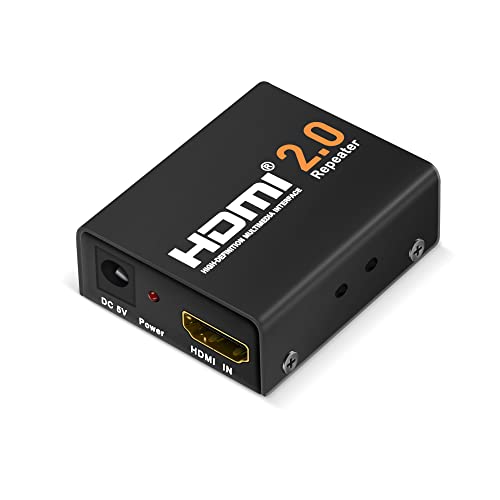
- 18 Gbps bandwidth with 4K/60 Hz support
- Stated transmission distance up to 200 feet
- Compact plug-and-play repeater with backup power cord
Best For: Extending a single HDMI connection in rooms and offices
Best with Extra Features
1x8 HDMI Distribution Amplifier

- Splits one HDMI source across eight outputs
- Supports 4K x 2K at 30Hz, Full HD, and 3D
- Metal enclosure aids cooling
Best For: Multi-display home, classroom, and office setups
Best HDMI 2.1 Feature Set
AC-DA14-AUHD-GEN2 1x4 Amplifier

- Offers 48 Gbps bandwidth and FRL 6
- Supports custom and extended EDID handling
- Extracts up to 7.1 digital or 2-channel analog audio
Best For: Advanced gaming, home theater, and professional AV systems
Compact Professional Pick
Kramer VM-2H2 HDMI Distribution Amplifier

- Compact 7.38 x 4.53 x 1-inch enclosure
- Lightweight at 14.1 ounces
- Designed for HDMI audio/video distribution
Best For: Space-conscious AV installations
Best Long-Distance 8-Display Solution – OREI 1×8 HDMI Extender
For installations that need to distribute one source across several rooms, this OREI system is a practical alternative to basic 4k video distribution amplifiers. It sends HDMI over CAT6/6a/7 cable to eight receivers, supports up to 4K at 30Hz, and includes a local loop-out connection.
Best For: Meeting rooms, bars, conferences, exhibitions, and multi-display installations requiring extended cable runs.
Pros:
- Distributes one HDMI source to eight displays over network cable.
- Supports 4K at 30Hz up to 165 feet and 1080p at 60Hz up to 230 feet.
- Includes IR pass-back, EDID management, power over LAN, and a local HDMI output.
Cons:
- 4K support is limited to 30Hz.
- Requires separate receiver units and compatible CAT6/6a/7 cabling.
This is the most flexible choice here for long-distance, multi-screen distribution, especially when eight remote displays and remote-source control matter more than higher-refresh-rate 4K.
Best Compact 18Gbps Pick – AVPro Edge AC-DA12-AUHD-GEN2
This AVPro Edge 1×2 unit is suited to stable, short-run 4K distribution where two outputs are enough. Its 18Gbps design, audio extraction, and downscaler on HDMI output 2 make it useful when a newer 4K HDR source must also work with a legacy display.
Best For: Two-display systems that need 18Gbps performance, audio extraction, or compatibility with older 4K equipment.
Pros:
- 18Gbps distribution for demanding 4K signals.
- Downscaler on HDMI output 2 helps accommodate legacy products.
- Supports audio extraction and can be cascaded for additional outputs or distance.
Cons:
- Provides only two outputs.
- The supplied notes do not specify supported resolutions or connector details beyond the model information.
Choose this model when system stability and mixed-generation equipment are priorities. It is a focused two-output option rather than a high-port-count distribution hub.
Best Budget 4K Splitter – Monoprice Blackbird 1×2
Monoprice Blackbird 4K 1x2 HDMI Amplifier Splitter - 48-bit Deep Color, 3D Video Support, Black
Check Price On AmazonThe Monoprice Blackbird is a straightforward option for basic 4k video distribution amplifiers needs: one HDMI source to two displays. It supports 4K at 30Hz, 3D video, 48-bit Deep Color, and several high-quality digital audio formats.
Best For: Home or small-office setups that need simple two-display HDMI splitting with broad audio and 3D support.
Pros:
- Splits one HDMI input to two sink devices.
- Supports 4K at 30Hz, 1080p at 120Hz, and 3D formats.
- Handles 48-bit Deep Color and formats including Dolby TrueHD, DTS-HD, and 7.1-channel LPCM.
Cons:
- Limited to two outputs.
- Uses HDCP 1.4 and supports 4K only at 30Hz.
This is a sensible choice for uncomplicated two-screen distribution when newer 18Gbps features are unnecessary and compatibility with 3D and multichannel audio is valuable.
Best 4K HDR Commercial Hub – AVPro Edge AC-DA14-AUHD-GEN2
AVPro Edge AC-DA14-AUHD-GEN2 1x4 18Gbps AUHD Distribution Amplifier with Advanced EDID Management
Check Price On AmazonFor commercial or residential installations requiring four HDMI outputs, this AVPro Edge model delivers a more capable platform than entry-level 4k video distribution amplifiers. It provides full 18Gbps bandwidth, HDR support, and advanced EDID management for stable signal handling.
Best For: Bars, restaurants, digital signage, home theaters, and other four-display installations where 4K HDR stability is important.
Pros:
- Offers four HDMI outputs from one source.
- Supports full 18Gbps bandwidth and HDR.
- Advanced EDID management and cascading support aid larger installations.
Cons:
- Provides fewer outputs than the OREI extender system.
- Uses HDMI distribution rather than the supplied notes’ long-distance CAT-cable receiver architecture.
This is the strongest fit for installers seeking four-output 4K HDR distribution with EDID control. Its emphasis is stable, high-bandwidth HDMI performance rather than very long cable runs.
Best Overall for Flexible 4K Distribution – Tripp Lite 8-Port HDMI Splitter
For buyers comparing 4k video distribution amplifiers, the Eaton Tripp Lite B118-008-4KL stands out as a flexible option for sending HDMI video to multiple displays. It supports 4K at 60 Hz, HDR10, and multi-resolution output, with push-button EDID control for easier system setup.
Best For: Installations that need eight HDMI outputs, 4K/60 Hz support, HDR10, and convenient EDID adjustment.
Pros:
- Supports 4K video at 60 Hz and HDR10.
- Distributes a source to up to eight HDMI displays.
- Push-button EDID control accommodates multi-resolution output setups.
- Includes a three-year limited warranty and access to Eaton technical support.
Cons:
- The supplied notes do not specify included HDMI cables or audio output formats.
- Its eight-output design may be more capacity than smaller setups require.
Choose this model when display compatibility and configuration flexibility matter as much as output count. The three-year warranty is also useful for buyers planning a longer-term installation.
Best for Home Theater Audio – KanexPro 1×8 4K HDMI Distribution Amplifier
Among 4k video distribution amplifiers, the KanexPro HDSP184K is a straightforward choice for distributing one 4K HDMI source to as many as eight displays. HDCP 2.2 compliance and support for lossless surround formats make it suitable for compatible home theater and presentation systems.
Best For: Eight-display systems that need 4K UHD distribution and support for Dolby Digital, DTS-HD, or Dolby TrueHD audio.
Pros:
- Distributes 4K HDMI video and audio to up to eight displays.
- Supports 1080p at 60 Hz as well as 4K UHD.
- HDCP 2.2 compliant for compatible protected content.
- Supports Dolby Digital, DTS-HD, and Dolby TrueHD audio.
Cons:
- The supplied notes list a one-year warranty, shorter than some alternatives.
- The notes do not specify 4K refresh rate or included cables.
This is a practical pick when broad audio-format support is central to the installation. Its 1×8 layout keeps the design simple: one HDMI source feeds multiple compatible displays.
Best for Long HDMI Runs – Flashmen HDMI 2.0 Booster
For buyers seeking compact 4k video distribution amplifiers for extending a connection, the Flashmen HDMI Booster 2.0 works as an inline repeater between two HDMI devices. It supports 18 Gbps bandwidth and 4K/60 Hz signals, with a stated transmission distance of up to 200 feet.
Best For: Conference rooms, offices, classrooms, and other setups where an HDMI signal needs boosting over a longer cable run.
Pros:
- Supports 18 Gbps bandwidth and 4K/2K at 60 Hz.
- HDCP 2.2 compatible and backward compatible with HDMI 1.x.
- Compact metal housing helps with heat dissipation.
- Plug-and-play design is powered by HDMI, with a backup power cord included for high-power devices.
Cons:
- This is a repeater for extending one HDMI connection, not an eight-output distribution amplifier.
- The supplied notes do not identify a standard power plug or detailed warranty length.
Consider this model when distance, size, and simple installation are priorities. It is better suited to strengthening a point-to-point HDMI run than to feeding several displays from one source.
Best with Extra Features – 1×8 HDMI Distribution Amplifier
If you need to send one HDMI source to several screens, this 1×8 model is a practical choice among 4k video distribution amplifiers. It mirrors a single input across eight HDMI outputs and supports 4K at 30Hz, along with Full HD and 3D sources.
Best For: Home entertainment setups, classrooms, offices, and installations requiring one source distributed to eight HDMI displays.
Pros:
- Distributes one HDMI input to eight identical outputs.
- Supports resolutions up to 4K x 2K at 30Hz.
- Compatible with consoles, streaming devices, Blu-ray players, TVs, projectors, and monitors.
- Heavy-duty metal enclosure helps with heat absorption and dissipation.
Cons:
- 4K support is limited to 30Hz.
- Designed for signal distribution rather than switching between multiple inputs.
Its eight-output design offers strong value when you need broad HDMI coverage from one source. The included 5V AC adapter and straightforward format make it suitable for uncomplicated multi-display installations.
Best HDMI 2.1 Feature Set – AC-DA14-AUHD-GEN2 1×4 Amplifier
For newer displays and gaming-focused systems, this 1×4 distribution amplifier stands out among 4k video distribution amplifiers with 48 Gbps bandwidth and HDMI 2.1b-oriented features. It also adds flexible EDID handling and audio extraction for more advanced installations.
Best For: Next-generation gaming, home theater, and professional AV systems using demanding HDMI 2.1 displays and multiple outputs.
Pros:
- Provides 48 Gbps bandwidth with Fixed Rate Link 6.
- Supports custom EDID blending and extended four-block EDID.
- Includes extracted audio support for up to 7.1 digital or two-channel analog audio.
- Includes a 12V power supply, terminal block, and mounting brackets.
Cons:
- Offers four output channels, fewer than eight-output models.
- Its advanced feature set may be more than basic distribution setups require.
This is the more specialized pick for installations where bandwidth, EDID compatibility, and audio routing matter. The included mounting hardware also makes it well suited to a structured AV rack or equipment installation.
Compact Professional Pick – Kramer VM-2H2 HDMI Distribution Amplifier
The Kramer VM-2H2 is a compact HDMI distribution amplifier for buyers who prefer a professional-brand solution in a small enclosure. Its supplied notes identify it as an audio/video distribution product with dimensions of 7.38 by 4.53 by 1 inch and a weight of 14.1 ounces.
Best For: Compact AV installations and buyers seeking a space-conscious Kramer distribution amplifier.
Pros:
- Compact 7.38 x 4.53 x 1-inch form factor.
- Lightweight design at 14.1 ounces.
- Purpose-built for HDMI audio/video distribution.
Cons:
- The supplied notes do not specify resolution, bandwidth, or output count.
- Limited feature information makes detailed compatibility comparison difficult.
The VM-2H2 is worth considering when compact dimensions and the Kramer brand are priorities. However, shoppers who need confirmed 4K specifications or detailed port information should verify those particulars before choosing it for a specific installation.
How We Picked the Best 4K Video Distribution Amplifiers
We focused on the specifications that most directly affect real-world performance: output count, HDMI bandwidth, supported resolution and refresh rates, HDR and HDCP compatibility, EDID controls, warranty coverage, and installation flexibility. The lineup includes compact splitters for simple home setups, higher-bandwidth distribution amplifiers for modern 4K sources, and models designed for longer runs or more demanding commercial environments.
We also considered whether each unit provides useful management features rather than judging products solely by the number of ports. A splitter that supports eight displays may be less useful than a four-output model if it cannot handle mixed display capabilities or the source’s required refresh rate.
Quick Comparison
| Best For | Look For | Recommended Output Count |
|---|---|---|
| Small home theater | 4K support, HDCP compatibility, simple setup | 1×2 |
| Several TVs or monitors | 18Gbps bandwidth, EDID management, HDR support | 1×4 |
| Classrooms and offices | Easy controls, reliable cooling, warranty coverage | 1×4 or 1×8 |
| Long cable runs | Signal extension, CAT cable support, repeater capability | Varies by installation |
| Professional AV systems | Advanced EDID, HDCP 2.2, robust build quality | 1×4 or 1×8 |
Key Buying Factors for 4K Video Distribution Amplifiers
Resolution, Refresh Rate, and Bandwidth
Check the exact format your source produces. Basic 4K at 30Hz requires less bandwidth than 4K at 60Hz with HDR and full-color signals. For current streaming devices, game consoles, and PCs, an 18Gbps HDMI 2.0-class amplifier is generally the safer choice than an older low-bandwidth unit.
HDCP and HDR Compatibility
HDCP support matters when distributing protected content from streaming boxes, Blu-ray players, and other commercial sources. HDCP 2.2 compatibility is particularly important for many 4K devices. If you use HDR, confirm that the amplifier and every connected display support the relevant HDR signal path.
EDID Management and Mixed Displays
EDID tells the source what the displays can accept. Advanced EDID controls can prevent blank screens when monitors have different resolutions or refresh rates. This feature is especially valuable in conference rooms, classrooms, and installations that combine newer 4K displays with older 1080p screens.
Output Count and Cable Distance
Choose more outputs than you currently need if the system may expand, but remember that every additional display can complicate signal negotiation. For long runs, use certified HDMI cables or a model with repeater, extender, or CAT-based transmission features. Distance claims depend heavily on cable quality, resolution, refresh rate, and interference.
Who Should Buy Which 4K Video Distribution Amplifiers?
Choose a compact 1×2 amplifier for a television-and-projector setup or another simple two-display arrangement. A 1×4 model is a practical middle ground for offices, classrooms, and home theaters with several screens. Select an 1×8 unit when one source must feed many displays, such as digital signage or a larger venue.
Buy an amplifier with advanced EDID controls when displays vary in age or capability. For gaming and premium 4K playback, prioritize 18Gbps operation, 4K at 60Hz, HDR, and HDCP 2.2. For installations where the source and displays are far apart, consider CAT-based extension or a dedicated repeater instead of relying on a basic HDMI splitter. Finally, verify connector layout, power requirements, warranty terms, and ventilation before mounting the unit permanently.