
Choosing among 4K streaming encoders means balancing image quality, latency, protocol support, connectivity, and workflow requirements. A compact HDMI unit may suit a creator or classroom, while professional productions often need SDI, HDR, redundant streaming, recording, or NDI support.
This roundup compares 10 noteworthy options across those use cases, from standalone HDMI and SDI encoders to production-focused systems built for cloud, local, and IPTV delivery.
Best 10 4K Streaming Encoders Picks for 2026
Best All-Around Production Encoder

- HDMI and SDI inputs with mixing
- 4K H.264/HEVC encoding
- Streams to six destinations while recording
Best For: Flexible live production workflows
Best for AV-over-IP Installations
- 4K60 H.264/H.265 encoding
- Triple simultaneous stream outputs
- PoE and analog audio embedding
Best For: Enterprise AV and control-room deployments
Best for HDR Remote Production

- 4Kp60 HDR with 10-bit 4:2:2 color
- Local and cloud streaming options
- Built-in collaboration features
Best For: On-set production and remote review
Best Budget-Friendly Full-HD Output
J-Tech Digital HDMI IPTV Encoder

- 4K60 input with 1080p60 output
- H.264, H.265, and MJPEG support
- PoE, audio embedding, and custom OSD
Best For: Churches, events, and Full-HD IPTV streaming
Professional SDI Pick

- Encodes SDI up to 4096×2160p30
- Supports multiple protocols and destinations
- Streams and records simultaneously
Best For: Professional SDI-based live production
Flexible HDMI Value
Multi-Protocol 4K HDMI Encoder
- Handles 4K at up to 30 fps
- Supports a wide range of streaming protocols
- Can output up to four streams
Best For: HDMI livestreaming across multiple platforms
HDMI Production Pick

- Encodes HDMI up to 4096×2160p30
- Provides HDMI loop-through monitoring
- Streams and records at the same time
Best For: HDMI production setups needing local pass-through
Best Compact NDI Encoder
ZowieBox 4K HDMI NDI Encoder/Decoder

- 4K capture with zero-lag HDMI passthrough
- NDI, SRT, RTMP(S), and RTSP support
- PoE, USB-C power, LCD, and tripod mount
Best For: Compact gaming and NDI video workflows
Best Professional SDI Encoder
Blackmagic Streaming Encoder 4K
- 4K60 H.264/H.265 streaming over SRT or RTMP
- 12G-SDI input with standards conversion
- Ethernet and mobile auto-failover
Best For: Broadcast and professional SDI production
Best Multi-Protocol HDMI Encoder
URayCoder UHE265-1L-4K HDMI Streaming Encoder

- 4K30 H.264/H.265 encoding
- Up to four simultaneous protocol outputs
- Built-in overlays and image adjustments
Best For: Flexible HDMI streaming and multi-platform delivery
Best All-Around Production Encoder – Magewell Ultra Encode AIO
The Magewell Ultra Encode AIO is a flexible choice among 4k streaming encoders for productions that need HDMI and SDI connectivity in one unit. It supports 4K encoding, multi-destination streaming, onboard overlays, and simultaneous recording for more involved live workflows.
Best For: Live producers who need HDMI/SDI flexibility, advanced processing, and multiple streaming destinations.
Pros:
- Accepts HDMI and SDI inputs, with picture-in-picture and side-by-side mixing.
- Supports up to 4K encoding with H.264 or HEVC compression.
- Streams to up to six destinations and can record while streaming.
- Includes overlays, PoE, Wi-Fi, 4G modem support, and API control.
Cons:
- Its broad professional feature set may be more than a simple streaming setup requires.
- SDI input supports up to 4096×2160p30, while HDMI supports up to 4096×2160p60.
Choose this model when your workflow spans multiple input types and destinations. Its recording, overlay, and control features make it particularly adaptable for live production environments.
Best for AV-over-IP Installations – ToVi X2 4K Network Streamer
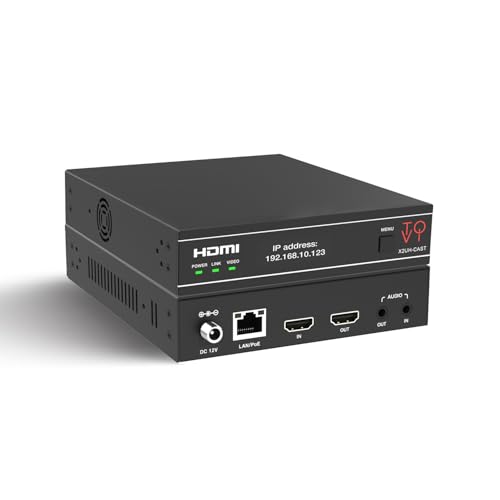
The ToVi X2 is a strong option among 4k streaming encoders for fixed AV-over-IP systems, control rooms, and continuous operation. It combines 4K60 encoding, triple-stream output, analog audio embedding, and enterprise-oriented network features.
Best For: Professional AV installations, control centers, and 24/7 HDMI streaming with flexible network distribution.
Pros:
- Supports 4K at 60Hz with H.264 and H.265 encoding.
- Provides simultaneous 4K, 1080p, and 720p stream outputs.
- Offers analog audio embedding and extraction for mixer or soundboard integration.
- Includes PoE, unicast/multicast streaming, EDID management, and 802.1X security.
Cons:
- Designed primarily for networked AV deployments rather than compact personal setups.
- The listed output profiles include lower-resolution secondary streams alongside the 4K stream.
This encoder fits buyers who need structured distribution across an AV network. Its PoE support, rack-mountable design, and extended control options are well suited to permanent installations.
Best for HDR Remote Production – Teradek Serv 4K
The Teradek Serv 4K targets production teams that need high-fidelity local or cloud delivery. As one of the more specialized 4k streaming encoders, it supports 4Kp60 HDR, 10-bit 4:2:2 color, secure compression, and built-in collaboration tools.
Best For: Camera teams, video villages, and remote collaborators working with HDR production footage.
Pros:
- Streams up to 4Kp60 HDR with 10-bit 4:2:2 color.
- Supports both HEVC and AVC compression with 256-bit encryption.
- Handles local streaming to up to four devices plus unlimited remote viewers through supported services.
- Includes voice chat, messaging, user management, and Frame.io integration support.
Cons:
- Its production-focused feature set may be unnecessary for basic HDMI streaming.
- Remote cloud viewing features depend on the supported Teradek workflow and internet access.
The Serv 4K is most compelling when image quality and collaboration matter more than a simple plug-and-stream setup. Its camera-mountable design and quiet cooling also suit on-set use.
Best Budget-Friendly Full-HD Output – J-Tech Digital HDMI IPTV Encoder
The J-Tech Digital HDMI IPTV Encoder is a practical pick among 4k streaming encoders when a 4K input is useful but the delivered stream is Full HD. It supports multiple protocols, analog audio embedding, custom on-screen branding, and PoE installation.
Best For: Churches, live events, and AV setups that need 4K60 input with 1080p60 streaming output.
Pros:
- Accepts 4K at 60Hz and outputs up to 1080p at 60Hz.
- Supports H.264, H.265, and MJPEG compression with numerous streaming protocols.
- Embeds analog audio through a 3.5mm input.
- Offers custom OSD logos, a no-signal screen, and PoE support.
Cons:
- Does not provide 4K streaming output; the listed output resolution is 1080p.
- PoE operation requires a compatible PoE network switch.
- Includes a one-year manufacturer warranty, shorter than some alternatives in this roundup.
This model makes sense for buyers who want flexible IPTV protocol support and simple installation without needing a 4K delivered stream. Its branding and audio features are useful for organized live broadcasts.
Professional SDI Pick – Compact 4K SDI Encoder
For professional workflows built around SDI sources, the Magewell Ultra Encode SDI Plus is one of the more versatile 4k streaming encoders. It supports up to 4096×2160p30 input, H.264 and H.265 encoding, multiple streaming protocols, NDI|HX, and simultaneous recording.
Best For: Broadcast, live production, remote contribution, corporate AV, education, and houses of worship using SDI equipment.
Pros:
- Supports 4K SDI encoding with H.264 or H.265 compression.
- Streams to multiple destinations using RTMP, RTMPS, SRT, NDI|HX, HLS, and UDP/RTP.
- Can stream and record simultaneously to internal, USB, or network storage.
- Includes overlays, scaling, cropping, Wi-Fi, Gigabit Ethernet, and PoE.
Cons:
- Designed for SDI sources rather than HDMI equipment.
- 4K encoding is limited to 30 fps.
- Professional features may be more than casual streamers need.
Choose this model when SDI compatibility and flexible contribution options matter most. Its built-in storage, NDI|HX support, and network connectivity make it especially suitable for installations that need both live streaming and recording.
Flexible HDMI Value – Multi-Protocol 4K HDMI Encoder
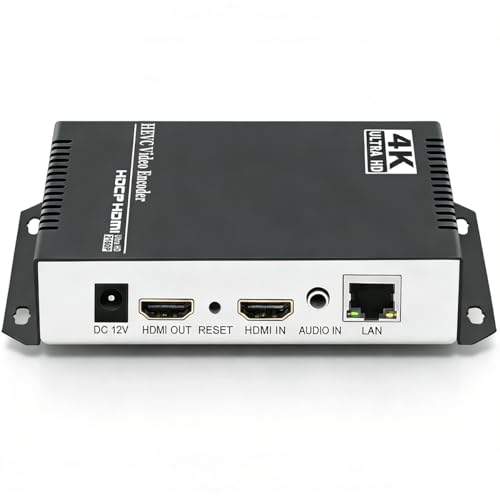
This URayCoder unit is a flexible option among 4k streaming encoders for HDMI sources. It accepts 4K video at up to 30 fps, supports H.265 and H.264, and can output multiple streams through a broad selection of protocols.
Best For: HDMI-based livestreaming to YouTube, Facebook, Twitch, Vimeo, OBS, and other compatible servers.
Pros:
- Supports 3840×2160 4K input and output at up to 30 fps.
- Offers RTSP, RTMP(S), SRT, HLS, UDP/RTP, WebRTC, FLV, and other protocols.
- Can output up to four streams using different protocols.
- Provides overlays, adjustable encoding settings, audio options, and remote management.
Cons:
- Does not provide the SDI-specific connectivity of the Magewell SDI model.
- Some advanced configuration options may require careful setup.
- The supplied details do not specify internal recording storage.
This is a practical choice if your cameras, computers, or switchers use HDMI and you want broad protocol compatibility. Its multi-stream output and customization tools are useful for creators or organizations distributing one source across several platforms.
HDMI Production Pick – 4K Encoder with Loop-Through
The Magewell Ultra Encode HDMI Plus combines 4K encoding with HDMI loop-through, making it a strong option among 4k streaming encoders for setups that need local monitoring. It supports up to 4096×2160p30, multiple streaming protocols, NDI|HX, and recording while streaming.
Best For: HDMI cameras, switchers, gaming systems, events, corporate AV, and education setups requiring pass-through monitoring.
Pros:
- Encodes HDMI video up to 4096×2160p30 using H.264 or H.265.
- HDMI loop-through supports local displays or pass-through to other equipment.
- Streams through RTMP, RTMPS, SRT, NDI|HX, HLS, and UDP/RTP.
- Records to 128 GB internal storage, USB drives, or network locations while streaming.
Cons:
- Limited to HDMI input rather than SDI sources.
- 4K operation is limited to 30 fps.
- Its professional networking and recording features may exceed basic streaming needs.
The loop-through connection is the deciding advantage here: you can send a feed online while keeping a local monitoring or pass-through path. It is a well-rounded fit for HDMI production systems that also need recording, overlays, and IP workflow support.
Best Compact NDI Encoder – ZowieBox 4K HDMI NDI Encoder/Decoder
For buyers comparing 4k streaming encoders for gaming, events, or flexible IP video setups, the ZowieBox offers a compact HDMI-to-network solution with NDI, RTMP(S), RTSP, and SRT support. It can capture up to 4K with zero-lag HDMI passthrough and operate as either an encoder or decoder.
Best For: PC-free game streaming, compact NDI workflows, PTZ camera setups, and portable live-production installations.
Pros:
- Supports up to 4K capture with zero-lag HDMI passthrough.
- Works with NDI|HX3, HX2, HX, SRT, RTMP(S), and RTSP workflows.
- Compact design includes an LCD status screen, tally light, PoE, USB-C power, and tripod mounting.
Cons:
- Encoder and decoder modes cannot run simultaneously.
- Full NDI signals are not supported.
- USB capture-card functionality is not currently supported.
The ZowieBox is a strong choice when portability and protocol flexibility matter more than a traditional rack-style design. Its mode limitations and lack of USB capture support should be considered before purchase.
Best Professional SDI Encoder – Blackmagic Streaming Encoder 4K
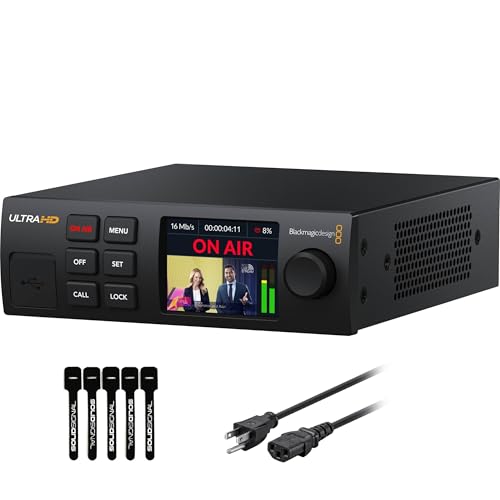
Among 4k streaming encoders, the Blackmagic Design Streaming Encoder 4K stands out for broadcast-oriented production. It accepts 12G-SDI sources up to DCI 4K60, encodes in H.264 or H.265, and streams over SRT or RTMP without requiring a separate encoding computer.
Best For: Professional SDI production, live events, broadcast control rooms, and streams that need connection failover.
Pros:
- Supports H.264 and H.265 streaming up to 2160p60.
- 12G-SDI input, loop output, and Teranex standards conversion support varied source formats.
- Gigabit Ethernet and USB-C smartphone tethering provide automatic connection failover.
- Includes closed-caption embedding, timecode, REST API control, tally, talkback, and webcam outputs.
Cons:
- Designed for SDI equipment rather than basic HDMI-only setups.
- Its broadcast feature set may be more than casual streamers need.
- Mobile connectivity requires a compatible smartphone and data connection.
This encoder is best suited to users who need dependable 4K60 SDI streaming and production-control features. Its standards conversion and auto-failover capabilities make it especially practical for professional live workflows.
Best Multi-Protocol HDMI Encoder – URayCoder UHE265-1L-4K HDMI Streaming Encoder
The URayCoder UHE265-1L-4K is a versatile option for shoppers evaluating 4k streaming encoders with broad protocol support. It accepts 4K HDMI input at up to 30 fps, supports H.264 and H.265 encoding, and can output up to four streams using different protocols.
Best For: HDMI-based streaming, multi-platform distribution, custom overlays, and installations requiring flexible network protocols.
Pros:
- Supports 3840×2160 input and output at up to 30 fps, plus up to 120 fps at 2K and lower resolutions.
- Handles RTSP, RTMP(S), SRT, HLS, UDP, WebRTC, and other listed protocols.
- Can output four video streams with different protocols for multi-platform delivery.
- Offers text, scrolling captions, logos, timestamps, cropping, rotation, and audio-input controls.
Cons:
- 4K operation is limited to 30 fps.
- Only one HDMI port is listed.
- The supplied product details do not specify the complete hardware feature set.
This encoder is a practical fit when protocol flexibility and simultaneous distribution are priorities. It is less suitable for buyers who specifically require 4K60 capture, but its overlay tools and multi-stream output add useful customization for online channels.
How We Picked the Best 4K Streaming Encoders
We evaluated these models by looking at their input type, supported output resolutions, encoding formats, streaming protocols, networking features, and production extras. HDMI models are often the easiest fit for cameras, switchers, and consumer video sources, while SDI models are better suited to longer cable runs and professional broadcast environments.
We also considered practical features such as HDMI loop-through, PoE, onboard recording, NDI support, audio connectivity, HDR or 10-bit handling, and whether a unit can stream locally as well as to cloud platforms. Because requirements vary widely, the best choice depends on the complete signal chain rather than resolution alone.
Quick Comparison
- Best for flexible live production: Magewell Ultra Encode AIO, with HDMI/SDI inputs, recording, mixing, and broad protocol support.
- Best for professional SDI workflows: Magewell Ultra Encode SDI Plus or Teradek Serv 4K.
- Best for HDMI installations: Magewell Ultra Encode HDMI Plus, ToVi, or J-Tech Digital models.
- Best for NDI-based systems: ZowieBox and Magewell Ultra Encode models.
- Best for straightforward SRT or RTMP delivery: Blackmagic Design Streaming Encoder 4K.
Key Buying Factors for 4K Streaming Encoders
Input and Pass-Through Connections
Start with the source equipment. HDMI is common for mirrorless cameras, computers, and consumer devices; SDI is more dependable for studio and event installations. An HDMI loop-through can send the source to a local monitor or switcher without adding another splitter.
Resolution, Frame Rate, and Color
Confirm whether 4K refers to input support, encoded output, or both. Some encoders accept 4K but stream at 1080p, which may be ideal when bandwidth or platform limits apply. If you work with HDR footage, check for 10-bit and 4:2:2 support rather than assuming every 4K device preserves those characteristics.
Codecs and Protocols
H.264 offers broad compatibility, while H.265/HEVC can reduce bandwidth at comparable quality when the receiving platform supports it. RTMP remains widely compatible; SRT is valuable for resilient contribution links, and RTSP, HLS, WebRTC, or NDI may matter for IPTV, monitoring, or low-latency network production.
Network and Workflow Features
Check Ethernet speed, Wi-Fi or cellular options, PoE requirements, local recording, audio inputs, and management tools. NDI support can simplify IP production, while dual-streaming or multiple simultaneous destinations may be important for distributed events.
Who Should Buy Which 4K Streaming Encoders?
Content creators and small venues should prioritize simple HDMI setup, loop-through, reliable RTMP, and manageable configuration. Broadcasters and event crews will benefit from SDI, redundant transport options, recording, and professional audio support. IPTV and institutional installers should focus on codec compatibility, multicast or UDP support, centralized management, and PoE. NDI production teams should choose a model with the required NDI version and verify that their network can carry the desired resolution and latency.
Before buying, confirm platform compatibility, maximum sustained bitrate, required cables, power method, and whether your network upload capacity can handle the intended stream. A well-matched 1080p workflow is often more dependable than forcing 4K through an undersized connection.